Monday, January 12, 2009

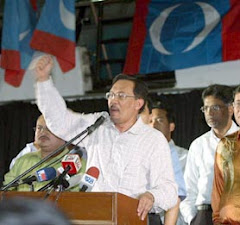
Anwar: 2 pendedahan Ezam sudah tidak relevan - MStar

Jan 12, 2009 Oleh ARIFFUDDIN ISHAK

KUALA LUMPUR:

Datuk Seri Anwar Ibrahim enggan memberi respon atau menjawab sebarang pertuduhan seperti yang dicabar oleh bekas Setiausaha Politiknya, Mohamad Ezam Mohd Nor mengenai dua perkara penting yang didedahkannya sewaktu berkempen di Kuala Terengganu kelmarin.

Beliau sebaliknya mendakwa Ezam diperalatkan oleh Umno dan Barisan Nasional (BN) dalam kempen pilihan raya kecil Kuala Terengganu untuk meraih undi.

"Saya tidak pernah respons kepada Ezam, sejak bila saya respons kepada dia?

"Di Permatang Pauh mereka gunakan dia, setiap pilihan raya kecil dia akan digunakan," katanya dalam sidang media di bangunan Parlimen hari ini.

Beliau berkata demikian bagi mengulas mengenai cabaran Ezam supaya menjawab pendedahan terbaru berhubung

Semalam, Ezam yang juga bekas Ketua Angkatan Muda Parti Keadilan Rakyat (PKR) mendedahkan bahawa bekas Timbalan Perdana Menteri itu pernah memintanya supaya menguruskan langkah berdamai dengan Tun Dr. Mahathir Mohamad tidak sampai seminggu selepas dipecat.

Malah Ezam turut mendedahkan tarikh tepat beliau melihat kandungan enam kotak rahsia yang dikaitkan dengan kononnya bukti gejala rasuah pemimpin-pemimpin Umno dan Barisan Nasional (BN) semasa berada dalam kerajaan.

Ditanya sama beliau ingin menafikan atau mengakui mengenai pendedahan Ezam itu, Anwar berkata, isu merupakan isu lama yang sudah tidak relevan.

"Dia cakap mengenai isu bila, 1998? Sekarang sudah 2009, dia tunggu 11 tahun untuk fikir," katanya.

Bagaimanapun Anwar yang juga Ketua Pembangkang di Parlimen berkata isu yang dibangkitkan Ezam tiada kaitan dengan pilihan raya kecil Kuala Terengganu.

"Apa isunya? Saya tak nampak sebarang isu yang cuba beliau bangkitkan," katanya.

Sunday, January 11, 2009

BN denies buying votes - Star

Jan 11, 2009

Reports by SAODAH ELIAS, R.S.N. MURALI, IAN MCINTYRE and NG SI HOOI

KUALA TERENGGANU: Deputy Prime Minister Datuk Seri Najib Tun Razak has dismissed opposition claims that the Government is trying to bribe the people of Kuala Terengganu by approving projects for them ahead of the Jan 17 by-election.

He said all projects announced for the area thus far were projects that were approved earlier by the Government as part of its stimulus package announced late last year.

“All the announcements that we have made here in the last few days were just the implementation of it.

“This is not a political bribe as those projects belonged to the people here.

“We are not buying votes. We are simply implementing plans and projects that have already been identified and approved even before there is a necessity for a by-election,” he told reporters after presenting cheques to government-aided people’s religious schools (SARS) here yesterday.

For instance, Najib said, the allocation given to the schools was part of the RM50mil ap­­proved by the Government last year and was not a new allocation meant to fish for votes.

The money would be disbursed to all 154 SARS nationwide that are registered with the Education Ministry, he said, adding that of that number, 14 were in Terengganu.

Asked about his closed-door meeting with Chinese groups on Friday, Najib said he reminded the Chinese that they had always been treated as part of the society.

He said the Chinese community in Kuala Terengganu had never been side-lined, either by the state or the Federal Government.

“Whatever is allocated to the Malays, they will also get. In the case of Chinese schools here, they are not just getting assistance from the Federal Government but also from the state government.

“So I had appealed to them not to forget what the Barisan Nasional government had done for them and not to be so easily swayed by sweet talk from groups from outside the state,” he said.

'When I came close to resigning' - NST

Jan 11, 2009 By : ANIZA DAMIS and ELIZABETH JOHN

Tan Sri Abdul Rashid Abdul Rahman regrets agreeing to the indelible ink request.

A magnet for controversy and a target of constant attacks, former Election Commission chairman Tan Sri Abdul Rashid Abdul Rahman has never shied from the limelight. He talks to ANIZA DAMIS and ELIZABETH JOHN

Q: In the 25 years with the Election Commission (EC), do you regret any decisions you have made?
A: My only regret is I should not have agreed to the request for the indelible ink. I agreed in good faith because I wanted to show that if this could assure voters and put to rest all allegations of cheating, then we would go ahead and do it. And because we could not do it, I regretted the decision to have the indelible ink.

This was the worst thing that happened in my career. The government rejected our proposed law.

Q: Did they reject it because it was unconstitutional or because it was disadvantageous to them?
A: I don't think it was disadvantageous to them because the prime minister and the deputy prime minister agreed.

I went to see them long before, and told them: what has the party in power got to hide? Nothing. There's no cheating in the elections. If this is a way to ensure there is no cheating, why not? It doesn't cost us very much. So they agreed.

But the attorney-general felt we were going beyond our right to impose conditions and possibly put hurdles in voters' way that they might not turn up.

That meant we were trying to deter people from voting or imposing some kind of 'roadblock'.

So, the government said we should give people a choice. If you don't want (to be inked) it's okay. We still have to give you (the right to vote). But that's ridiculous. What kind of law is that? It's not conclusive.

Q: In the end, what was the reason given for the cancellation?
A: It was ultra vires the Constitution -- Article 119.


Q: What about those police reports?
A: That was also another reason. But the constitutional issue was strong enough a reason. I had the feeling that if I continued with it, I would be impeached in Parliament. I was trying to find the means but the A-G said no, don't take that risk.

Q: Do you think he was justified in making that decision?
A: They are the law experts. I cannot say it is not a justifiable decision. They know what they are saying. If people are not happy, they can go for a judicial review. Take it to court.

Q: What happened to the indelible ink in the end? Were we able to sell it and recoup our losses?
A: I was told it has been disposed of. How, I don't know. I was told it had been disposed of through the proper channels.

Q: It's been nearly a year since the elections. Do you see that the government has changed its mind about introducing indelible ink?
A: Opposition parties will have to get the party in power to talk. If they are really interested in getting all this done, they should get the government to review the law.

Q: When the indelible ink thing happened, you were very quiet at that time. Usually you have lots of things to say.
A: I was working very hard, running here and there. I felt very sad I was not able to do that (use the ink). I was trying my best to think of how to do it. I didn't want to talk to people about anything. People were asking when I was going to do the training (on applying the ink on voters' fingers) but I couldn't tell them as the government had told me that I couldn't do this (introduce the indelible ink).

But still I tried, until I was told that I would get into trouble if I did it, that I could be impeached. That's when I abandoned it.

That's why it was only on the 4th (of March) that I announced it. I should have announced it on the 13th (of February) when I was told -- the day when Parliament was dissolved. I thought: mati lah saya itu macam (Oh no, I'm done for).

I felt like resigning but I was persuaded by my staff not to. If I had resigned, there would have been a big crisis.

Q: But it might have sent a very clear message about yourself.
A: A clear message, yes. But it would have been very bad for the country. I discussed it with my staff.

Q: When the government told you on the 13th, didn't you ask them why they didn't tell you earlier?
A: The cabinet only sat on the 13th just before the dissolution. They did not indicate to me that they were going to reject it.

Q: But even so, there would have been a need for parliamentary amendments.
A: They could have stood their ground and let us use it. And then, let the people challenge (its constitutionality) in court.

And who would have wanted to challenge it?

The opposition wouldn't have challenged it because they are the ones who asked for it. It would be stupid for them to challenge it. I was told: "We were advised by the A-G".

I asked: "Who persuaded him?"

Q: Who persuaded him?
A: I don't know.

Q: You said the stamp duty issue arose because someone from the legal fraternity pointed it out to the A-G. Who was that person?
A: From the A-G's Chambers. I think somebody alerted the A-G's Chambers.

And we were blamed for that. All these years, we never had stamp duty. Suddenly, we were told to impose it. If they had ignored it, it would have been all right, because that's been the practice all along.

Q: But about the possible impeachment, was that brought up by the A-G's Chambers also?
A: No. I was asked to think deeply about it, because I would be going against the Constitution. That was when I knew it was over.

Q: In hindsight, do you wish you had created a fuss at the time?
A: No. I wouldn't do such a thing.

Q: But you were very disappointed?
A: Completely disappointed. I could not do what I wanted to do, as my last service.

By right, if there is a big demand for that kind of thing, the EC has to comply because it relates to public confidence.

Q: On your first day of retirement, you announced that you were going to sue some politicians. Why?
A: They said things which indicated that I was corrupt and biased towards the government.

These people will have to prove that in court. I want to know exactly what I did.

Q: Why not just leave all that behind instead?
A: No, I cannot keep quiet. I cannot let it go just like that. Why did that fellow have to say that? Why did he have to tarnish my image?

I can go on stage and talk if I want to but I am bound by the Official Secrets Act. That's why I take people to court.

You tell the country, you tell the court what I took. Prove it, don't just say it.

Q: Who are the people you intend to sue?
A: I will not say. It is with the lawyers. It may not even go through. The lawyers may advise me to forget it.

Q: How many do you intend to sue?
A: Below half a dozen.

Q: For how much?
A: It's not for the money. I want an apology.

Q: Why did you wait until you retired before you sued these people?
A: I don't want to get the Election Commission involved. I want to do it as Rashid, because they attacked me as Rashid.

Q: Are you going to join a political party?
A: I am studying all these political parties. If I join, I would want one that is multiracial.

There are some multiracial (parties) in terms of their constitution but not membership.

Q: Is there any party that you feel is truly multiracial?
A: There is.

Q: After all these years of being a civil servant, you would consider being a member of a political party?
A: I may consider.

Q: Do you have any aspirations to run for elections?
A: No. If I join a political party, I may be able to help that party in electoral matters.

To change from being an administrator to being a politician is tough.

Q: So, you might join a political party, but not run for elections?
A: No. I have never aspired to be a candidate. I may join, not that I'm certain of it.

Q: Have you been approached by any political party to be an election consultant?
A: No. But I've been approached by a university to be a professor.

Q: Are you going to take that up?
A: No, I have not replied. But I am hanging on to that letter.

Q: Why are you interested in a multiracial party?
A: I think it's time this country looked at the people's representative as a representative for all. Not just Umno for Malays, and MCA for Chinese.

You cannot go on in that manner. I think it's time we relooked this.

A wakil rakyat must represent all. Just because he's Indian, he shouldn't only talk about the Indians.

I wonder what this representative in Kapar is trying to do. He talks so much about the Indians suffering, as if the Chinese and Malays there are not suffering.

I know Kapar very well. If you go beyond the main road, it's terrible. It's a slum, and people from all backgrounds are suffering.

They need help badly in Kapar. I wonder why this man only talked about the Indian community.

Of course, maybe they need the most help; but you can't talk that way.

I think this country needs multiracial solutions to multiracial problems. We should not go separate ways in tackling problems. Poor is poor, no matter what.

Take care of every Malaysian. Make sure they have enough to eat, clothes to wear, schools to attend.

Q: The political party that you identify, is it in the government or opposition?
A: Where is there a multiracial party in the government?

People misunderstand me. Even Parti Keadilan Rakyat thought I supported the party in power because when I gave a talk somewhere, I said given the multiracial, multireligious setup in the country, the only party that can run it is the party that appeals to all.

The party that can solve all these problems is the Barisan Nasional because it is the marriage of so many racial parties. Together, they can strike a balance and an understanding. They sit down and they run the country.

So, in the absence of any other party that has the same kind of appeal and ability, the BN is the only party that can run this country.

That's what I said, within that context. But they took as me saying that only BN can run this country.

Q: Does the opposition think you are anti-opposition?
A: Because their demands are not met. And they are not met because I have no power.

They should be grateful to me, because of what I say. If you want to run this country, there must be a two-party system. You must offer an alternative.

I'm glad to see that they got together even though in terms of ideology, they are far apart.

They may quarrel every day until the end of the five-year term, but I hope they stick together because they are running the state governments.

I think the country is moving towards a two-party system, which is good, because you provide alternative solutions.

Q: How serious are you about joining a multiracial party?
A: Serious, but nobody has asked me to join their party.

Q: How would you rate your 25 years with the Election Commission (EC)?
A: I'm quite happy to have been there for at least six general elections.

We have delivered free and fair elections and, most importantly, we have given the country a legitimate government.

People have not had their rights taken away.

There is a choice in this country. Voters are able to vote freely and political parties have been able to take part in the electoral process.

Q: Bukit Bendera member of parliament Liew Chin Tong called your term as EC chairman "an unmitigated failure". He said you did not carry out any electoral reforms.
A: It is not our job to do that. That's not in our terms of reference. We merely give indications. It is for political parties to pressure (the government) because reform depends very much on political will.

Q: You keep talking about the laws that the EC has no power over and that the government does. Are you implying that ruling parties do not play fair?
A: No, these laws are just there. The EC is only given half or three-quarters of the powers it should have. That's why I made the demand to put us in full control.

The power over security during the campaign lies with the police. Then, the Information Ministry takes the major part of the function to control the media.

For corruption, there is the anti-corruption body. And for other things, it is other authorities. The right to put up posters and banners is under the local authorities.

So, many people play a role during the elections. And if people don't like them, it reflects on the electoral process. If that reflection is bad, it boomerangs onto the EC.

Although we have made tremendous achievements in the elections, nobody seems to be thankful to us.

People don't see it in that light because people don't understand electoral laws.

Q: Is it possible to achieve the perception of free and fair elections here?
A: It's possible. It's not difficult. You review the law. I told the prime minister all the problems.

Q: Do you think there is sincerity in the government or opposition to ensure a free and fair election?
A: Is the country ready to take on changes in the electoral process? That's debatable.

When we began introducing electoral laws in 1957, we had these three very big sensitive matters: racial, religious and cultural.

On top of that, we had a rural-urban divide.

I consider these as matters that influenced the government then to limit the EC to handling only the basic things in an election. There must be a debate on this. The government should have taken the initiative to call for some kind of forum.

So, what extent of freedom, what basic fundamental rights are people going to be given as candidates or voters?

Are we ready to have changes in our democratic practices? Can we give total freedom to everybody? Can they go shouting all over the place, touching on sensitive matters?

When you talk of an electoral democracy, you have to think of all this. Are you not going to impose a permit for people to go canvassing?

They don't do this in other countries. Just tell the police: "I'm going to have a gathering in front of Bangsar Village."

Is that possible here? No. But in some countries, it is.

Q: Do you think the EC's public relations are not well handled?
A: We have meetings and dialogues. But when we tell them that something is beyond us, they are not happy.

We are being handicapped by the fact that within the law, there are missing components.

All the demands that came to the commission are beyond our powers. You have to ask the government, because the commission doesn't make laws. How we wish we could comply.

Q: How much sway do politicians or the government have over the EC?
A: In terms of law-making and the interpretations of laws, we have to go through the government.

In other words, when we are seen to be handicapped and there is no will on the part of the ruling party to correct that handicap, we are under their control.

Whoever is controlling the government will have the advantage to call the shots.

They have the advantage of deciding when to dissolve Parliament or to control the media. But it should be under the EC during the elections.

Q: Have you ever had to fix an election?
A: No.

Q: Have you ever been asked to assist in the outcome of an election?
A: No, never. Had I been asked, I would have resigned long ago. I would not want to do that kind of job.

Will they bite the 'hand that feeds'? - Malaysiakini

Andrew Ong | Jan 11, 09 3:18pm

The battle for the 8,787 Chinese votes in Kuala Terengganu is now in full swing with both Barisan Nasional and Pakatan Rakyat pulling all the stops to ensure support from the community.

Chinese voters were believed to have helped BN clinch victory in the Kuala Terengganu parliamentary seat during the last two general elections and all eyes are on whether they would reprise their role on Jan 17.

PAS, who is fielding five-term Wakaf Mempelam assemblyperson Abdul Wahid Endut, has practically left all the campaigning for Chinese votes to coalition partners DAP and PKR. This was confirmed by PAS deputy-president Nasharuddin Mat Isa yesterday.


DAP and PKR leaders are going all out to 'educate' locals on national issues such as corruption, the slump in the economy, the teaching of maths and science in English, the Internal Security Act and deteriorating race relations.

"A parliamentary by-election is not to gauge the state government. Instead, it is an opportunity for the Chinese voters to vote PAS as a protest against Umno and BN’s bad policies at the national level," said Teja assemblyperson Chang Lih Kang (PKR) who has been campaigning here since nomination day.

The opposition ceramah in Chinese areas have been able to draw larger crowds than usual and DAP and PKR activist believe they are making a breakthrough just six days into the campaign.

Gov't has been 'fair'

On the BN front, particularly MCA, has a far better grassroots following among the Chinese community.

Unlike the opposition, BN campaigners are leaving aside national issues and banking on reminding voters of their long standing quid pro quo relationship with the state government.

The logic behind this is that the state government, through MCA, had looked after the needs of the Chinese community and voting for the opposition would be deemed an ungrateful act.

"The government is rich and has been fair in distributing the state's wealth. There may be problems faced by the Chinese in other states but not here," summed up Terengganu Chinese Assembly Hall president Foo Chih Wan.

Foo said BN has shored up significant amount of goodwill from the Chinese community since PAS' religious conservative reign of the state between 1999 and 2004.

According to Foo, the Chinese community has enjoyed the benefits derived from oil royalties through the federal and state governments funding of schools, places of worship and Chinese guilds since 2001.


Election goodies


For this by-election campaign alone, a cursory look at the federal and state government pledges and distributions specific to the Chinese community total in excess of RM12 million, according to media reports over the past week.

The most significant allocation took place on Jan 5, a day before nomination day, where the state government distributed about RM2.7 million in cash to about 9,000 needy and elderly Chinese.


Menteri Besar Ahmad Said has thus far pledged RM3.3 million for the construction of a hall for the Chinese community in Bukit Kecil, with the ground breaking ceremony slated for Jan 13.

The state government further approved RM2.8 million for the refurbishing of the sole Chinese school in Kuala Terengganu, SJK (C) Chung Hwa Wei Sin. The school's brass band will receive another RM200,000.

Another RM110,000 was allocated to 40 Chinese religious organisations.

In addition to the allocations from the state government, the state MCA has obtained federal allocation worth RM205,000 for two temples while Education Minister Hishamuddin Hussien on Jan 5 announced a RM2,926,000 allocation for 10 Chinese schools in the state.


'Don't bite the hand that feeds'


Several Chinese guild leaders when approached have expressed hope that Chinese voters in Kuala Terengganu would not bite the hand that feeds, especially since the community forms a mere three percent population in the state.

Chinese guilds in Kuala Terengganu are highly influential among the community and this has prompted high-profile meetings between BN leaders and guild leaders.

Deputy Prime Minister Najib Abdul Razak himself held a closed-door dialogue with guild leaders for more than two hours on Friday night, while MCA president Ong Tee Keat and Gerakan president Dr Koh Tsu Koon held similar meetings as well.

Meanwhile, MCA appears to have another ace up its sleeve in the form of its state assemblyperson for Bandar constituency, Toh Chin Yaw.

MCA's campaign is portraying Toh as the sole Chinese representative in the state assembly whose position cannot be guaranteed should BN candidate Wan Abdul Farid Salleh loses.

Despite the odds stacked against them, DAP and PKR hope to ride on the wave of discontent among non-Malay voters to secure a victory in Kuala Terengganu.

Terengganu PAS supporters club spokesperson Chin Fook Cheen expressed confidence that voters would not buy into the ’candies’ being doled out by BN.

However, Chin conceded that trying to get the young voters working in other states to return home to cast their ballots would be a problem.

"It is now very close to Chinese New Year. It is likely that many will be unable to obtain leave from work," he said.

A popular estimate is that about 2,500 Chinese voters are currently outside Kuala Terengganu.

Tuesday, January 6, 2009

Dr M: Wan Farid a proxy for Pak Lah - Malaysiakini

By S Pathmawathy | Jan 5, 09 4:01pm

Former premier Dr Mahathir Mohamad expressed disappointment with the selection of Wan Ahmad Farid as the Barisan Nasional candidate in the Kuala Terengganu by-election.

Wan Ahmad will contest the parliamentary seat that had been held by deputy education minister Razali Ismail up to his death on Nov 28 last year.

“The choice of the candidate by BN is really very bad because everybody sees him just as a proxy... someone to be used later on if Najib becomes the prime minister,”

Mahathir (left) claimed at a press conference in Putrajaya today.

While Mahathir did not elaborate, he was obviously referring to Wan Ahmad being closely linked to his successor-turned-nemesis Prime Minister Abdullah Ahmad Badawi.

The Umno candidate had served as political secretary to Abdullah when he was home minister in 2003.

Wan Ahmad had been appointed deputy home minister after the general election in March last year, and was reappointed a senator last month.

He resigned his ministerial post last Friday and his senatorial post today, in order to contest the by-election on Jan 17.

'PM’s particular choice'

Mahathir also dismissed claims that the by-election is an important battle for Deputy Prime Minister Najib Abdul Razak, who is leading the election campaign.

wan ahmad farid terengganu 221007“They are trying to project it as Najib's test (because) if he becomes the prime minister then these are people (including Wan Ahmad, right) who will be surrounding Najib,” said Mahathir.

Asked whether he felt the opposition has a chance of bagging the seat, Mahathir said: “I don't know about the opposition having an upper hand but I think it is an even tide.”

He said the by-election would not bring about much difference for the BN as “it is not a major fight”.

“But of course, the candidate (from) Umno was the prime minister's particular choice, because he is working with the prime minister,” he said.

Wan Farid will stand against Mohd Abdul Wahid of PAS and possibly Angkatan Keadilan Insan Malaysia vice-president Harun Moham.

Buy over major highways, govt urged - Star

Jan 6, 2009 By ANDREA FILMER

GEORGE TOWN: The Federal Government should buy over all the major highway concessions in the country and run them as a business.

Penang Chief Minister Lim Guan Eng said that in the long term, the Government and people of Malaysia would gain from such a move, instead of private companies.

He said this after going through the details of the declassified information of the nation’s toll agreements.

“It would not cost much to buy over certain major highways like the North-South Expressway (NSE) or the Penang Bridge, and the Government would be able to regain the investment through toll collection.

“It is not expensive to buy some of these highways. For example, the NSE has been capitalised at RM8.8bil which is not very much for over 600km of road. PLUS, the operator of NSE, gains some RM1.1bil a year through tolls.

“Wouldn’t it be better for the Government and Malaysia’s 27 million people to gain this revenue instead of one private company?” said Lim.

Referring to details of the first Penang Bridge concession agreement with Mekar Idaman Sdn Bhd, Lim claimed the contract was lopsided and greatly favoured the concessionaire.

“The deal includes a one-way compensation agreement for the termination of the contract, meaning the company could have walked away without penalty while the Government would have had to pay billions if it decided to terminate the agreement.

“The compensation rate of a RM550mil bank debt plus other calculated compensations based on the bridge’s average revenue or estimated net profit is a heavy burden to the Government and also unfair to Malaysians,” he said.

On how the Government could improve in building the Second Bridge, Lim said all agreements should be done by open tender with no profit guarantees with regard to traffic volume and bank loans.

“The Government should also be the one to set toll rates and not the private company,” Lim said.

By-election: Three-cornered fight - Star

Jan 6, 2009 By SA’ODAH ELIAS, R.S.N. MURALI, NG SI HOOI and IAN McINTYRE

KUALA TERENGGANU:

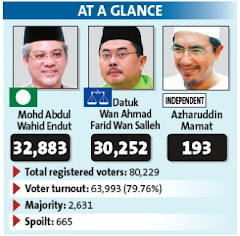
(From left) PAS' Mohd Abdul Wahid Endut, Barisan Nasional’s Datuk Wan Ahmad Farid Wan Salleh and Independent Azharudin Mamat alias Adam will be contesting in the Kuala Terengganu parliamentary seat by-election.


The Kuala Terengganu by-election on Jan 17 will see a three-cornered tussle between Barisan Nasional, PAS and an independent candidate.

Returning officer Datuk Mat Razali Kassim said that Barisan candidate Datuk Wan Ahmad Farid Wan Salleh filed his papers at 9.13am on Tuesday, followed by PAS’ Mohd Abdul Wahid Endut five minutes later.

Surprise independent candidate Azharuddin Mamat @ Adam handed in his papers two minutes before the end of the nomination period.

The 46-year-old candidate had arrived about 9.20am, but was seen leaving the nomination centre a few minutes later, presumedly to look for an eligible sponsor and seconder.

Independent candidate Isma Airfath had earlier stated his intention to contest, but did not turn up for nomination.

Mat Razali said that four objections had been received, but none accepted.

Wan Farid had arrived at the State Stadium which served as the nomination centre slightly before 9.00am, accompanied by a large crowd of supporters.

The Barisan procession, which according to police numbered between 15,000 and 20,000 people, had started from Terengganu Mentri Besar Ahmad Said’s official residence about 500m away.

PAS supporters arrived from the Batu Bersurat roundabout at the opposite end of Jalan Sultan Mahmud, where the nomination centre is situated.

Leading the Barisan group was Deputy Prime Minister Datuk Seri Mohd Najib Tun Razak and other party leaders including MCA president Datuk Seri Ong Tee keat, Gerakan president Tan Sri Dr Koh Tsu Koon, MIC secretary-general Datuk Dr S. Subramaniam and Umno vice-president Tan Sri Muhyiddin Yassin.

The 10,000 or so PAS supporters were led by party president Datuk Seri Abdul Hadi Awang, deputy president Nasharuddin Mat Isa, Selangor Mentri Besar Tan Sri Khalid Ibrahim and DAP national adviser Lim Kit Siang.

Wan Ahmad Farid was proposed by Terengganu Umno Youth chief Mohd Sabri Alwi and seconded by MCA secretary-general Datuk Wong Foon Meng.

Abdul Wahid’s proposer was Terengganu PAS Commissioner Datuk Mustafa Ali and his seconder was Md Azmi Lok Yusof.

Azharuddin was proposed by his brother Ahmad Affendi Shah Mamat @ Adam and seconded by Zakaria Abdullah.

Keadilan Insan Malaysia (Akim) candidate Harun @ Ab Rahman Mohamad, who had stated his intention to contest, arrived about 9.20am. However, he quickly pulled out of the race, saying he was throwing his support behind the PAS candidate.

The atmosphere around the nomination centre was relatively calm. Shouts of “Allahu Akbar” (God is Great) and party slogans were heard only sporadically from supporters who were kept behind a barricade about 50m from the entrance.

Barisan supporters at the opposite end of the barricade were relatively quiet throughout the nomination process.

Najib, when asked about this restraint, said: “Why should we make noise? It is not necessary.”

Police had closed several roads near the stadium to facilitate crowd control, while police helicopters hovered above. No untoward incidents were reported.

The by-election is being held following the death of incumbent Datuk Razali Ismail on Nov 28 last year.

There are 80,229 voters in the constituency, of whom 2,036 are postal voters.