Jul 10, 209 By IAN McINTYRE
ianm@thestar.com.my
KUALA KRAI: Kelantan PAS wants to have a public forum with representatives from Petronas and Umno to discuss the state’s demand for over RM1bil in oil royalty.
It can be held before the Manek Urai state by-election on July 14, state PAS elections director Abdul Fatah Haron said.
“Since there is much confusion, a public forum is the best way to resolve the issue which has been dragging on for the past two decades,” he told the media.
Kelantan claims that the Federal Government owes the state RM1bil in petroleum royalty from the exploration of oil and gas in the state since 2004. States like Terengganu, Sabah and Sarawak have all enjoyed such royalty except Kelantan, which is under PAS rule.
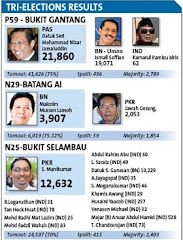
On the by-election, Abdul Fatah said PAS has entered its second phase of the Manek Urai campaigning, having covered 70% of the constituency since it began Monday.
The seat fell vacant following the death of PAS assemblyman Ismail Yaacob on May 24.
In the 2008 general election, Ismail, a five-term assemblyman, defeated Barisan candidate Zulkifli Omar with a 1,352 majority votes.
The by-election will see a straight fight between Barisan Nasional’s Tuan Aziz Tuan Mat and PAS’ Mohd Fauzi Abdullah.
Friday, July 10, 2009

Kedah DAP to rejoin state Pakatan - Star
Jul 10, 2009 By EMBUN MAJID
ALOR SETAR: Kedah DAP will rejoin the state Pakatan Rakyat coalition after Mentri Besar Datuk Seri Azizan Abdul Razak said he would set up an action committee to discuss state issues.
Kedah DAP chairman Thomas Su said that the decision was made during the state DAP committee meeting here.
“We will inform the DAP Centre Executive Committee about our decision and we will retract our letter to quit the state Pakatan,” he told newsmen during a press conference here Friday.
He said that the assurance given by Azizan during the meeting with DAP adviser Lim Kit Siang had renewed the state DAP’s confidence in the PAS-led government.
He said that the setting up the action committee would enable the coalition parties in Pakatan to voice their opinion regarding any state issue.
The state DAP had suggested that six people each from PAS, DAP and PKR sit in the committee and the committee meet at least once a month, he said.
Su also said that Azizan had given the assurance that he would settle the matter regarding the relocation of the illegal slaughterhouse in Kampung Berjaya, Jalan Putra here.
He said that the new site would be in Kampung Sungai Tok Pawang in Gurun.
Su said he believed that there would be a problem with the new site as the land was already used for pig rearing.
Azizan had also assured that the state would speed up the process to allow the construction of the slaughterhouse at the new site, he said.
On July 1, Su announced that Kedah DAP had pulled out from the state Pakatan Rakyat coalition, saying the PAS-led government was not giving equal treatment to all Kedahans.
He was quoted as saying that this included the demolition of an illegal pig slaughterhouse at Kampung Berjaya, Jalan Putra here.
He said the state government had failed to handle the issue properly.
During Friday’s press conference, Su denied that the state DAP decision to quit the state Pakatan was merely a threat.
He said that the earlier decision was made because the state DAP had lost confidence in the PAS-led government.
“Azizan has given his assurance and I believe that everything will go well from today onwards,” he said.
ALOR SETAR: Kedah DAP will rejoin the state Pakatan Rakyat coalition after Mentri Besar Datuk Seri Azizan Abdul Razak said he would set up an action committee to discuss state issues.
Kedah DAP chairman Thomas Su said that the decision was made during the state DAP committee meeting here.
“We will inform the DAP Centre Executive Committee about our decision and we will retract our letter to quit the state Pakatan,” he told newsmen during a press conference here Friday.
He said that the assurance given by Azizan during the meeting with DAP adviser Lim Kit Siang had renewed the state DAP’s confidence in the PAS-led government.
He said that the setting up the action committee would enable the coalition parties in Pakatan to voice their opinion regarding any state issue.
The state DAP had suggested that six people each from PAS, DAP and PKR sit in the committee and the committee meet at least once a month, he said.
Su also said that Azizan had given the assurance that he would settle the matter regarding the relocation of the illegal slaughterhouse in Kampung Berjaya, Jalan Putra here.
He said that the new site would be in Kampung Sungai Tok Pawang in Gurun.
Su said he believed that there would be a problem with the new site as the land was already used for pig rearing.
Azizan had also assured that the state would speed up the process to allow the construction of the slaughterhouse at the new site, he said.
On July 1, Su announced that Kedah DAP had pulled out from the state Pakatan Rakyat coalition, saying the PAS-led government was not giving equal treatment to all Kedahans.
He was quoted as saying that this included the demolition of an illegal pig slaughterhouse at Kampung Berjaya, Jalan Putra here.
He said the state government had failed to handle the issue properly.
During Friday’s press conference, Su denied that the state DAP decision to quit the state Pakatan was merely a threat.
He said that the earlier decision was made because the state DAP had lost confidence in the PAS-led government.
“Azizan has given his assurance and I believe that everything will go well from today onwards,” he said.
Thursday, July 9, 2009
Dr Khir's Mansion A Hot Topic In Selangor Assembly
SHAH ALAM, July 9 (Bernama) -- Former Selangor Menteri Besar's 'palatial mansion' in Section 7 here, reportedly worth RM24 million, was among hot topics discussed at the Selangor state assembly here on Thursday.
Sekinchan state assemblyman Ng Suee Lim (DAP) questioned Dr Khir's financial means for the purchase of the mansion situated on two plots of land measuring 50,000 sq ft or 1.17acres when he was the Selangor Menteri Besar.
Ng raised the issue during the debate on an extra RM120 million budget allocation for 2009.
Earlier Ng quipped that the people of Kajang, where Dr Mohd Khir's clinic was located, must have been lining up to extract their tooth at his dental clinic, for him to be able to earn a hefty income before becoming the Menteri Besar.
Dr Khir explained that his income as a dentist was high because he not only specialised in dentistry but also specialised in cosmetic dentistry and that the cost of a dental implant was anything between RM40,000 to RM50,000.
The former Menteri Besar said even before becoming a Menteri Besar, he was driving a Mercedes Benz.
Ng later urged Dr Khir to produce evidence of his income tax payments.
As the debate went on, Lau Weng San (DAP-Kampung Tunku) stood up to ask whether Dr Khir was willing to sell his mansion for RM8 million, which was actually twice the purchase price of the mansion bought with a HSBC Bank loan three years ago.
However, Dr Khir said: "I am willing to sell the house for RM24 million as estimated."
Sekinchan state assemblyman Ng Suee Lim (DAP) questioned Dr Khir's financial means for the purchase of the mansion situated on two plots of land measuring 50,000 sq ft or 1.17acres when he was the Selangor Menteri Besar.
Ng raised the issue during the debate on an extra RM120 million budget allocation for 2009.
Earlier Ng quipped that the people of Kajang, where Dr Mohd Khir's clinic was located, must have been lining up to extract their tooth at his dental clinic, for him to be able to earn a hefty income before becoming the Menteri Besar.
Dr Khir explained that his income as a dentist was high because he not only specialised in dentistry but also specialised in cosmetic dentistry and that the cost of a dental implant was anything between RM40,000 to RM50,000.
The former Menteri Besar said even before becoming a Menteri Besar, he was driving a Mercedes Benz.
Ng later urged Dr Khir to produce evidence of his income tax payments.
As the debate went on, Lau Weng San (DAP-Kampung Tunku) stood up to ask whether Dr Khir was willing to sell his mansion for RM8 million, which was actually twice the purchase price of the mansion bought with a HSBC Bank loan three years ago.
However, Dr Khir said: "I am willing to sell the house for RM24 million as estimated."
Parents unhappy over decision to revert - Star
Jul 9, 2009
KUALA LUMPUR: Many parents and students are very disappointed at the Cabinet’s decision to reverse the Teaching of Science and Mathematics policy.
Said mother of three Kam Swee Har: “Language is not just about teaching grammar and writing essays; it is the whole application of the language.
“The exposure is different when you’re learning technical subjects like Science or Maths.”
Engineer and father of four, Sulaiman Mahran, agreed: “Technical terms need to be absorbed in English, so strengthening English in general is not going to help in Maths and Science.”
Azra Banu, who has a child in Year Six, pointed out that it is the rural students who will lose out in the long run.
Businesswoman Haili Abdul Jamil, who has two children in Years One and Two, is seriously considering enrolling her children in an international school following the decision.
The impact of the decision is particularly hard on students who will enter Form Four in 2012.
Form One student Anisa Sulaiman is anxious about switching to Bahasa Malaysia in the two subjects when she gets into Form Four in 2012.
“I have been learning Maths and Science in English, so it will be difficult if we change the medium of instruction later on,” she said.
In Penang, Han Chiang High School Just English centre adviser Ooi Lay Le said the standard of English among students would drop if the two subjects were not taught in the language.
“We are going backwards,” said Ooi who has been teaching for 40 years.
SJK (C) Union Bahasa Malaysia Committee head Cheah Choo Suan, 55, said teaching the subjects in English would have helped broaden students’ knowledge of new terminologies and improve their command of the language.
Year Five student R. Abirami, 11, from SK Convent Green Lane, said it would be hard for her to adapt to the new system.
“We have memorised the scientific terms in English,” she said. “I’m afraid it will be hard to re-learn them in Bahasa Malaysia.”
In Johor, some parents are even considering sending their children to Singapore where they can learn in English.
Dr Santhi Sivalingam Moorthy, 41, said she would seriously consider transferring her three children, aged between five and 10, to Singapore schools now.
KUALA LUMPUR: Many parents and students are very disappointed at the Cabinet’s decision to reverse the Teaching of Science and Mathematics policy.
Said mother of three Kam Swee Har: “Language is not just about teaching grammar and writing essays; it is the whole application of the language.
“The exposure is different when you’re learning technical subjects like Science or Maths.”
Engineer and father of four, Sulaiman Mahran, agreed: “Technical terms need to be absorbed in English, so strengthening English in general is not going to help in Maths and Science.”
Azra Banu, who has a child in Year Six, pointed out that it is the rural students who will lose out in the long run.
Businesswoman Haili Abdul Jamil, who has two children in Years One and Two, is seriously considering enrolling her children in an international school following the decision.
The impact of the decision is particularly hard on students who will enter Form Four in 2012.
Form One student Anisa Sulaiman is anxious about switching to Bahasa Malaysia in the two subjects when she gets into Form Four in 2012.
“I have been learning Maths and Science in English, so it will be difficult if we change the medium of instruction later on,” she said.
In Penang, Han Chiang High School Just English centre adviser Ooi Lay Le said the standard of English among students would drop if the two subjects were not taught in the language.
“We are going backwards,” said Ooi who has been teaching for 40 years.
SJK (C) Union Bahasa Malaysia Committee head Cheah Choo Suan, 55, said teaching the subjects in English would have helped broaden students’ knowledge of new terminologies and improve their command of the language.
Year Five student R. Abirami, 11, from SK Convent Green Lane, said it would be hard for her to adapt to the new system.
“We have memorised the scientific terms in English,” she said. “I’m afraid it will be hard to re-learn them in Bahasa Malaysia.”
In Johor, some parents are even considering sending their children to Singapore where they can learn in English.
Dr Santhi Sivalingam Moorthy, 41, said she would seriously consider transferring her three children, aged between five and 10, to Singapore schools now.
It’s saddening, says Mahathir - Star
Jul 9, 2009
PUTRAJAYA: The future of our schoolchildren will be compromised with the Government reversing the teaching of Science and Mathematics from English to Bahasa Malaysia, Tun Dr Mahathir Mohamad said.
Dr Mahathir, who was behind the original policy of teaching both subjects in English, said his intention was to ensure that Malaysians were able to face global challenges at the earliest opportunity.
Expressing sadness on the policy reversal, he said schoolchildren would find it difficult to know more about the developments in the field of Science.
“These matters, of course, cannot be resolved overnight. But it’s the Government’s responsibility to train and supply capable teachers. I’m confident that our teachers will be able to study and teach in English,” he told reporters at his Perdana Leadership Foundation office yesterday.
Dr Mahathir said it was good that more teachers would be trained in English.
“But if we can train teachers to learn English, why can’t we do the same by training them to learn and teach Science and Mathematics in English?,” the former Prime Minister asked.
Dr Mahathir also questioned why no one protested when the medium of teaching in English in the colonial times was changed to Bahasa Malaysia.
“And at that time, not many teachers knew the national language. Now, it’s all right if we mix a little bit of Malay and English, but at the same time we need to improve the ability of our teachers too,” he added.
On his meeting with Deputy Prime Minister Tan Sri Muhyiddin Yassin, who is the Education Minister, before the new policy was announced, Dr Mahathir said he was only given a briefing.
PUTRAJAYA: The future of our schoolchildren will be compromised with the Government reversing the teaching of Science and Mathematics from English to Bahasa Malaysia, Tun Dr Mahathir Mohamad said.
Dr Mahathir, who was behind the original policy of teaching both subjects in English, said his intention was to ensure that Malaysians were able to face global challenges at the earliest opportunity.
Expressing sadness on the policy reversal, he said schoolchildren would find it difficult to know more about the developments in the field of Science.
“These matters, of course, cannot be resolved overnight. But it’s the Government’s responsibility to train and supply capable teachers. I’m confident that our teachers will be able to study and teach in English,” he told reporters at his Perdana Leadership Foundation office yesterday.
Dr Mahathir said it was good that more teachers would be trained in English.
“But if we can train teachers to learn English, why can’t we do the same by training them to learn and teach Science and Mathematics in English?,” the former Prime Minister asked.
Dr Mahathir also questioned why no one protested when the medium of teaching in English in the colonial times was changed to Bahasa Malaysia.
“And at that time, not many teachers knew the national language. Now, it’s all right if we mix a little bit of Malay and English, but at the same time we need to improve the ability of our teachers too,” he added.
On his meeting with Deputy Prime Minister Tan Sri Muhyiddin Yassin, who is the Education Minister, before the new policy was announced, Dr Mahathir said he was only given a briefing.
MB vs MB: Nizar granted leave to appeal - Star
Jul 9, 2009 By M. MAGESWARI
PUTRAJAYA: The Federal Court has granted Datuk Seri Mohammad Nizar Jamaluddin leave to appeal the Court of Appeal’s May 22 ruling that Datuk Dr Zambry Abdul Kadir was the rightful mentri besar of Perak.
However, the court rejected Nizar’s application for a stay of execution on the appellate court’s decision, which means Zambry will continue to act as the chief executive of the state.
Court of Appeal president Justice Alauddin Mohd Sheriff, who headed a three-man panel, granted the application to appeal after no objections were raised.
Justice Alauddin and the other two judges, Chief Judge of Malaya Justice Arifin Zakaria and Federal Court judge Justice Zulkefli Ahmad Makinuddin, however, unanimously refused to grant a stay order against the lower court’s ruling on May 22.
For the leave application, the apex court allowed the formulation of three questions:
·whether the Perak Mentri Besar’s post may be and/or has been vacated under Article 16(6) of the Perak Constitution;
·whether the determination of the issue of confidence in the Perak Mentri Besar has to be made by members of the legislative assembly in its meeting via vote of no-confidence or by other means;
·and if the Mentri Besar refuses to tender the resignation of the executive council, could he be dismissed from office, his post be deemed vacant, or his post vacated under the Perak Constitution.
The court, however, did not set a date to hear the leave application.
On May 11, High Court (Appellate and Special Powers) judge Justice Abdul Aziz Abdul Rahim granted a declaratory relief to Nizar that he still is and was the Mentri Besar (MB) at all material times. However, following an appeal by Datuk Dr Zambry Abdul Kadir, the Court of Appeal’s three-man panel on May 22 unanimously declared the latter as the rightful Perak MB.
In his suit filed on Feb 13, Nizar challenged the legitimacy of Dr Zambry and the new state government.
At the outset of the proceedings yesterday, Nizar’s counsel Datuk S. Ambiga informed the Bench that her client’s lead counsel Sulaiman Abdullah was unable to be present due to his health reasons.
Ambiga said the parties had resolved three questions for the leave application.
Attorney-General Tan Sri Abdul Gani Patail, who acted as intervener, and Datuk Cecil Abraham who represented Dr Zambry as lead counsel, confirmed to the panel that they had no objections for leave.
Ambiga then applied for a stay against the Court of Appeal decision.
In elaborating the grounds for the stay application, Ambiga said essentially many of Nizar’s policies had been reversed that was detrimental to the welfare of the people of Perak.
Among the actions which Ambiga submitted that Nizar claimed did not have any benefit for the people of Perak included the failure to implement welfare programmes for senior citizens and poor as per allocated budget, the delay in the implementation of Ipoh Sentral transport project, the approval of 14,000ha of land to private companies, the auction of 15 Camry cars used as officials cars by Nizar and former exco team, the cancellation of the service of 817 village heads and 342 councillors.
“That is our case for stay, so that no steps are taken to reverse any of those policies,” she said.
Cecil opposed to the stay saying that the court had no jurisdicton to interfere in the executive power of MB and his executive council.
“Whether the policy is right or not, it is up to the politicians,” he said adding that there was no special circumstance and it was highly improper to grant a stay of execution.
Cecil said he was prepared to expedite the hearing of the leave.
“If the stay is granted, the High Court order will be reinstated and the applicant (Nizar) will become the Mentri Besar. This is what the court should not do,” he urged.
Abdul Gani, who opposed the stay, noted that Dr Zambry was acting as MB to maintain his status quo and the state of affairs while Nizar failed to show special reasons to warrant for the stay.
In reply, Ambiga said the court must give an interim order to prevent prejudice against Nizar.
Speaking to reporters later, Nizar said he was not satisfied with the implementation of certain policies and applied for stay to ensure the status quo and welfare of the people of Perak.
“If an agreement is signed with a company, it will be difficult to reverse it,” he added.
PUTRAJAYA: The Federal Court has granted Datuk Seri Mohammad Nizar Jamaluddin leave to appeal the Court of Appeal’s May 22 ruling that Datuk Dr Zambry Abdul Kadir was the rightful mentri besar of Perak.
However, the court rejected Nizar’s application for a stay of execution on the appellate court’s decision, which means Zambry will continue to act as the chief executive of the state.
Court of Appeal president Justice Alauddin Mohd Sheriff, who headed a three-man panel, granted the application to appeal after no objections were raised.
Justice Alauddin and the other two judges, Chief Judge of Malaya Justice Arifin Zakaria and Federal Court judge Justice Zulkefli Ahmad Makinuddin, however, unanimously refused to grant a stay order against the lower court’s ruling on May 22.
For the leave application, the apex court allowed the formulation of three questions:
·whether the Perak Mentri Besar’s post may be and/or has been vacated under Article 16(6) of the Perak Constitution;
·whether the determination of the issue of confidence in the Perak Mentri Besar has to be made by members of the legislative assembly in its meeting via vote of no-confidence or by other means;
·and if the Mentri Besar refuses to tender the resignation of the executive council, could he be dismissed from office, his post be deemed vacant, or his post vacated under the Perak Constitution.
The court, however, did not set a date to hear the leave application.
On May 11, High Court (Appellate and Special Powers) judge Justice Abdul Aziz Abdul Rahim granted a declaratory relief to Nizar that he still is and was the Mentri Besar (MB) at all material times. However, following an appeal by Datuk Dr Zambry Abdul Kadir, the Court of Appeal’s three-man panel on May 22 unanimously declared the latter as the rightful Perak MB.
In his suit filed on Feb 13, Nizar challenged the legitimacy of Dr Zambry and the new state government.
At the outset of the proceedings yesterday, Nizar’s counsel Datuk S. Ambiga informed the Bench that her client’s lead counsel Sulaiman Abdullah was unable to be present due to his health reasons.
Ambiga said the parties had resolved three questions for the leave application.
Attorney-General Tan Sri Abdul Gani Patail, who acted as intervener, and Datuk Cecil Abraham who represented Dr Zambry as lead counsel, confirmed to the panel that they had no objections for leave.
Ambiga then applied for a stay against the Court of Appeal decision.
In elaborating the grounds for the stay application, Ambiga said essentially many of Nizar’s policies had been reversed that was detrimental to the welfare of the people of Perak.
Among the actions which Ambiga submitted that Nizar claimed did not have any benefit for the people of Perak included the failure to implement welfare programmes for senior citizens and poor as per allocated budget, the delay in the implementation of Ipoh Sentral transport project, the approval of 14,000ha of land to private companies, the auction of 15 Camry cars used as officials cars by Nizar and former exco team, the cancellation of the service of 817 village heads and 342 councillors.
“That is our case for stay, so that no steps are taken to reverse any of those policies,” she said.
Cecil opposed to the stay saying that the court had no jurisdicton to interfere in the executive power of MB and his executive council.
“Whether the policy is right or not, it is up to the politicians,” he said adding that there was no special circumstance and it was highly improper to grant a stay of execution.
Cecil said he was prepared to expedite the hearing of the leave.
“If the stay is granted, the High Court order will be reinstated and the applicant (Nizar) will become the Mentri Besar. This is what the court should not do,” he urged.
Abdul Gani, who opposed the stay, noted that Dr Zambry was acting as MB to maintain his status quo and the state of affairs while Nizar failed to show special reasons to warrant for the stay.
In reply, Ambiga said the court must give an interim order to prevent prejudice against Nizar.
Speaking to reporters later, Nizar said he was not satisfied with the implementation of certain policies and applied for stay to ensure the status quo and welfare of the people of Perak.
“If an agreement is signed with a company, it will be difficult to reverse it,” he added.
A prima facie farce in Zambry v Nizar - Malaysiakini
By NH Chan Jul 8, 09 12:01pm
Gobbledegook and regurgitation in Zambry v Nizar
I shall start with an aside on the dictionary definition of the two words which feature in the title of this article.
'Gobbledegook' means unintelligible language.
'Regurgitate' means repeat information without understanding it. 'Regurgitation' is the noun.
After you have read the article you should have an inkling of what I am trying to suggest with the words. You can then judge for yourself
There are only two points that really matter in this appeal: Clauses (2)(a) and (6) of Article 16 of the Perak constitution:
(2)(a) His Royal Highness shall first appoint as menteri besar to preside over the Executive Council a member of the Legislative Assembly who in his judgment is likely to command the confidence of the majority of the members of the Assembly;
nizar appeal to federal court 190609 07(6) If the menteri besar ceases to command the confidence of the majority of the members of the Legislative Assembly, then, unless at his request His Royal Highness dissolves the Legislative Assembly, he shall tender the resignation of the Executive Council.
The language of these two clauses, Clause (2)(a) and Clause (6), is easy to understand.
There is no ambiguity. Clause (2)(a) is definitive. It is only in this clause that the Ruler has been given the discretion to appoint a Menteri Besar which is based on his judgment.
On the other hand, it is only in Clause (6) where it is said that if the Menteri Besar ceases to command the confidence of the majority of the members of the Legislative Assembly then he would be able to ask the Ruler to dissolve the Assembly.
If the request for the dissolution of the Assembly is withheld by the Ruler (who has the discretion to do so under Article 1 8(2)(b)), the incumbent Menteri Besar has to tender the resignation of the Executive Council.
It is important that we notice that there is no provision for the incumbent Menteri Besar to resign. In fact, in the present case, the incumbent Menteri Besar Nizar had refused to resign even though .he was ordered by the Ruler to do so.
Of course, all of us know that the Ruler has no such power to order anyone to do anything. It was unconstitutional of the Ruler to do so.
While members of the Executive Council hold office at the pleasure of the Ruler, it is not so with the Menteri Besar. Clause (7) of Article 16 states:
(7) Subject to Clause (6) a member of the Executive Council other than the Mentri Besar shall hold office at His Royal Highness' pleasure,
That said, I return to the first part of Clause (6) which I am going to
discuss below.
The proper duty of the conjunction "if" is to introduce a conditional sentence.
The operative word in Clause (6) is the conjunction "if'. I refer to 'Fowler's Modern English Usage, Second Edition', where it says:
if. To avoid possible ambiguity it may be prudent to confine if to its proper duty of introducing the protasis of a conditional sentence, and not to use it as a substitute for though or whether or (with not) to introduce a possible alternative.
In case you do not know the meaning of the word "protasis", it means the clause that states the condition in a conditional sentence. In English the protasis is generally introduced by if or unless.
But don't trust Microsoft's word processor because it suggests the word "protasis" does not exist in the English language.
Of course, Fowler is the authority on the usage of the English language (Churchill wrote to the Director of Military Intelligence about the plans for the Normandy landings, "Why must you use intensive here?
Intense is the right word. You should read Fowler' s Modern English Usage on the use of the two words"). Or you may use a good dictionary, not a condensed one, and you will find the word.
nizar appeal to federal court 190609 04The dictionary meaning of the conjunction "if' means "on condition that, whenever" or "supposing that, in the event that".
In the present context, if is used to mean "on condition that, whenever".
So that Clause (6) is to read like this: On condition that "the menteri besar ceases to command the confidence of the majority of the Members of the Legislative Assembly, then," he can request the Ruler to dissolve the Assembly. This sentence means that "whenever" a Menteri Besar has ceased to command the confidence of the majority of the Assembly, he can request the Ruler to dissolve the Assembly. As stated in Fowler, the proper duty of "if' is to confine the word to introducing the protasis of a conditional sentence.
The condition in the sentence is that the MB's loss of confidence in the Legislative Assembly has to be established first before the MB can request the Sultan to dissolve the Assembly.
Therefore, it is only on the condition that a menteri besar has lost (ceased to command) the confidence of the majority of the Assembly before he can request the Ruler to dissolve the Assembly.
Definitely, it is not up to Nizar the incumbent menteri besar to say that he has lost the confidence of the Assembly.
How could he be sure of that without a vote being taken at the Assembly?
At best, Nizar could only be guessing. Obviously, the only way in which it could be shown with any degree of certainty that Nizar had lost the confidence of the majority of the members of the Assembly is to go to the Assembly itself for a vote to be taken.
But what happens when an MB had lost a formal vote of confidence in the Assembly and still refused to resign?
But then, one may ask the hypothetical question (because this is not the case here), what happens when an MB knows by a vote being taken in the Legislative Assembly that he has lost the confidence of the majority of the Assembly?
Can he refuse to resign? Professor Kevin YL Tan in his essay which appears on the web portal LoyarBurok tells us that: This happened in Kelantan in 1977 when its MB, Datuk Mohamed Nasir refused to resign even though he had lost a formal vote of confidence in the Kelantan LA, been sacked by his own party, and had his request for dissolution of the LA refused by the Sultan of Kelantan.
The impasse led to the declaration of a state of emergency by the Federal Government that lasted three months, after which the LA (legislative assemby)was dissolved for fresh elections.
zambry vs nizar court of appeal 220509Alas, this single precedent is not particularly instructive. No legal solution was possible and ultimately, the situation was resolved politically by the Sultan dissolving the LA and allowing fresh elections to be called.
Perhaps, all rulers and governors should, as a matter of course, accede to requests by their respective MBs to dissolve the LA for fresh elections to be called unless the ruler has a premonition that a calamity might befall the state if he so acceded.
That way, new mandates are quickly determined and the business of government can proceed once a new leadership is established.
Indeed, the sultan of Perak supported this view of a ruler's powers when he was Lord President.
In his 1992 essay, 'The Role of Constitutional Rulers', he opined: "... under normal circumstances, it is taken for granted that the Yang diPertuan Agong would not withhold his consent to a request for dissolution of Parliament. His role under such a situation is purely formal."
This point was picked up by counsel for Nizar and cited with approval by the High Court.
The Sultan has no explicit power to dismiss an MB under the Perak Constitution. Indeed, neither is the Yang di-Pertuan Agong empowered to dismiss a Prime Minister under the Federal Constitution.
It seems that ordinary people are better than these judges because they could understand what the two clauses mean.
Now that you are apprised of the meaning of the two clauses that really matter in the appeal, you should be in a better position than the appellate judges who have missed the points to come to their decision.
We all know that whenever there is a situation when there is no Menteri Besar, such as when the incumbent MB dies or resigns or has been disqualified as an assemblyman (because Nizar is an assemblyman) or has been removed from office by the assembly, then the Ruler "shall first appoint as Mentri Besar to preside over the Executive Council a member of the Legislative Assembly who in his judgment is likely to command the confidence of the majority of the members of the Assembly": so says Article 16(2)(a).
This is the only occasion in which a Ruler can use his 'judgment" to select and appoint a Menteri Besar.
We also know that a Menteri Besar, once he has been appointed by the Sultan under Clause (2)(a), cannot be removed by him. The MB does not hold office at the Sultan's pleasure.
The Sultan has no power to dismiss the incumbent Menteri Besar Nizar Jamaluddin or to declare the office of Menteri Besar vacant: so says Article 16(7), "Subject to Clause (6) a member of the Executive Council other than the Menteri Besar shall hold office at His Royal Highness' pleasure" (the emphasis is mine).
nizar and perak pakatan adun tree planting event 270509 02So that when Nizar refused to resign after the Sultan has declined to dissolve the Legislative Assembly, the Sultan has no power to dismiss him nor has he the power to appoint another Menteri Besar when Nizar is still the Menteri Besar as he has not resigned his office.
So then, how are we to determine a loss of confidence in the Assembly? Certainly not by an outsider like us. Not even Nizar himself was in any position to say that he did not command the confidence of the majority of the Legislative Assembly. Only the Assembly can determine if Nizar has lost the confidence of the majority of its members.
Therefore, the reality of the situation is that Nizar is still the menteri besar when he refused to resign and the Sultan has no power to dismiss him or to deem the office of Menteri Besar has fallen vacant. The Sultan has no discretion or power to appoint a second Menteri Besar when the incumbent is still in office.
The Perak constitution does not provide for two menteris besar.
Any decision of the courts otherwise is a perverse one because such a decision is not made according to the Laws of the Constitution of Perak.
Don't you think all of you ordinary people are better judges than these recalcitrant judges of the Court of Appeal?
At least (now that you are informed of the constitutional provisions) you know how to apply the relevant law which is applicable in the present case, whereas the judges don't seem to know how to do it.
Now that you know the law which applies, you are in a position to judge the two judges.
So far the Court of Appeal has issued two written judgments. Let us see if the judges who wrote them come up to your expectations.
Raus Sharif JCA who sat as the chairman of this Court of Appeal meandered through 43 tedious pages of his 48 page judgment before he came to the conclusion that Article 16(6) makes no reference to a motion of loss of confidence to be passed by the Legislative Assembly and therefore he concluded that the High Court judge had erred in law. This is what Raus JCA said, p 43:
For the above reasons, I find that the learned judge had erred in law in concluding that the only manner in which the loss of confidence of the majority of members of the Legislative Assembly could only be ascertained by way of motion to be passed in the Legislative Assembly. Such a finding is contrary to the provisions of Article XVI(6) of the Perak State Constitution which makes no reference to such a motion having to be tabled.
Remember my explanation above about the conjunction if? In the instant case the use of the conjunction it means "on condition that" or "whenever".
So that the opening words of Article 16(6) should read, thus: On condition that "the Menteri Besar ceases to command the confidence of the majority of the members of the Legislative Assembly, then," he can request the Ruler to dissolve the Assembly. In other words, the loss of confidence in the Legislative Assembly must be established first before the MB can make his request to the Ruler for a dissolution of the Assembly.
Obviously the only way to establish that Nizar has lost the confidence of the majority is to ask the members of the Assembly themselves.
sivakumar and zambry at perak state assembly 130509 04It would be incorrect to ask Nizar because he could only guess at his own popularity.
Undoubtedly, you must never ask the Ruler to determine the loss of confidence of a menteri besar in the legislative assembly as he has no power to determine on the status of the MB's popularity in the assembly.
And if the Court of Appeal were to confer such power on the Ruler, then it is a blatant refusal of the court to administer justice according to the Laws of the Constitution of Perak.
Of course, in Article 36(2) the sultan is given a general power "to prorogue or dissolve the legislative assembly".
Yet, the judge has relied on the Ruler's determination that Nizar no longer commands the confidence of members of the assembly. This is what Raus Sharif JCA said, at p 40 of his 48-page judgment:
It is an undisputed fact that His Royal Highness interviewed the 3 independent members separately in order to ascertain whether they were really supporting Barisan National. They informed His Royal Highness that they no longer supported Nizar as the menteri besar. Instead they declared their support to Barisan Nasional.
At the end of it, His Royal Highness was satisfied that with the 31 members of the Legislative Assembly supporting the Barisan Nasional, Nizar no longer command the confidence of the majority of the mambers of the Legislative Assembly.
This is a trashy piece of reasoning coming from an appellate judge. Raus Sharif JCA seems not to know that the Ruler is only a constitutional monarch with no prerogative power to do anything but that which the law allows him.
Plainly, the use of the conjunction if in Clause (6) speaks volumes. The loss of confidence of the MB in the Legislative Assembly must be established first before the MB can make his request to the Sultan to dissolve the Assembly. In this case Nizar requested the Sultan to dissolve the Legislative Assembly before it could be established that the MJ3 has lost the confidence of the majority in the Assembly.
Without doubt, it must not be left to interested parties - neither Nizar nor Zambry and his cohorts - to determine the loss of confidence of a Menteri Besar in the legislature.
Not even a constitutional monarch could determine the loss of confidence of a Menteri Besar in the Legislative Assembly because he has no power to do so.
Not even the judges can confer on themselves a power which does not exist to determine the loss of confidence in the Legislative Assembly of a Menteri Besar except the Assembly itself. It would be unfair and unjust to do so.
Judgment of Ahmad Muarop JCA
Ahmad Maarop JCA arrived at the same conclusion as Raus Sharif JCA except that Ahmad Maarop JCA is more long-winded. At page 42 of his 76 page convoluted judgment Ahmad Maarop JCA said:
In conclusion, I hold that there is no mandatory and1or express requirement in the Perak State Constitution that provides that there must be a vote of no confidence passed in the Legislative Assembly against Nizar before he ceased to command the confidence of the majority of the members of the Legislative Assembly.
The fact that he ceased to command the confidence of the majority of the members of the Legislative Assembly under Article XVI(6) could be established by other means.
zambry perak state pc 130509 03Thus, His Royal Highness was right in making enquiries to satisfy himself as to whether Nizar had in fact ceased to command the confidence of the majority of the members of the Legislative Assembly, in considering Nizar' s request for the dissolution of the legislative assembly.
It took this judge 42 pages to reach this conclusion.
At the recent launch of my book, How to Judge the Judges, on 29 June 2009 Justice Gopal Sri Ram FCJ remarked, "But where a judgment is tainted with intellectual dishonesty there is nothing much you can do except to expose the fallacy of the grounds put forth to justify a conclusion already reached".
Now let us expose the fallacy of the finding of this judge.
The judge said that whether Nizar had ceased to command the majority in the Assembly could be established by other means. One may ask, what other means could there be? He could only give one example.
He said, "Thus, His Royal Highness was right in making enquiries to satisfy himself as to whether Nizar had in fact ceased to command the confidence of the majority of the members of the Legislative Assembly, in considering Nizar's request for the dissolution of the Legislative Assembly".
But, all of us know that the Sultan has no power to do anything except that which the law allows him. As professor Andrew Harding has correctly said in his essay 'Crisis of Confidence and Perak's Constitutional Impasse' dated June 8, 2009 which is featured on the web portals Malaysian Insider and loyarburok.com:
.... the issue seems to become, who was empowered to make the judgment as to whether the MB still had the confidence of a majority? The Judge gave a correct answer to this question by saying it is the legislature, not the head of state.
.....
But, as the Judge also said, it is in any event clear that the head of state is not given the power under Article 16(6), as he is under Article 16(2)(a), to make a judgment as to matters of confidence
The Judge in Professor Harding's essay is the much respected Mr. Justice Abdul Azis of the High Court.
Conclusion
I trust we have exposed the fallacy of the grounds put forth by the two judges of the Court of Appeal.
All of you, (the ordinary people) who have been informed of the relevant provisions of the Laws of the Constitution of Perak by reading this article, knew that there are only two clauses of Article 16 which apply to the points that really matter before the Court of Appeal.
In Clause (2)(a) the head of state is empowered to make a judgment as to matters of confidence. Whereas in Clause (6) he is not given the power to do so but the legislature is.
Justice Abdul Aziz in the High Court gave the correct answer by saying it is the legislature, not the head of state, who is empowered to make the judgment as to whether the MB still had the confidence of a majority.
And, I trust, all of you would agree with him.
Raus Sharif and Abmad Maarop JJCA are wrong. They are wrong because there is no empowering provision in Article 16(6). They did not apply the law as it stands.
Indeed they have blatantly refused to apply the Laws of the Constitution of Perak. They should be ashamed of themselves for not administering justice according to law. The common people of this country can now judge them for what they are.
The full text of the two judgments can be found on the Internet. If you, as a layman, find the judgments unintelligible then that is what the word gobbledygook means.
On the other hand, if you find the lengthy judgments merely repeating information which is unnecessary to the two points that matter in the appeal then that is precisely what regurgitation means.
So now you can appreciate the title of this essay.
NH CHAN is a former Court of Appeal judge famous for his 'All is not well in the House of Denmark' comment regarding judicial corruption. He was referring to the Kuala Lumpur High Court's commercial division located in Wisma Denmark. The quote is based on Shakespeare's 'Something is rotten in the state of Denmark'. He now lives in Ipoh.
Gobbledegook and regurgitation in Zambry v Nizar
I shall start with an aside on the dictionary definition of the two words which feature in the title of this article.
'Gobbledegook' means unintelligible language.
'Regurgitate' means repeat information without understanding it. 'Regurgitation' is the noun.
After you have read the article you should have an inkling of what I am trying to suggest with the words. You can then judge for yourself
There are only two points that really matter in this appeal: Clauses (2)(a) and (6) of Article 16 of the Perak constitution:
(2)(a) His Royal Highness shall first appoint as menteri besar to preside over the Executive Council a member of the Legislative Assembly who in his judgment is likely to command the confidence of the majority of the members of the Assembly;
nizar appeal to federal court 190609 07(6) If the menteri besar ceases to command the confidence of the majority of the members of the Legislative Assembly, then, unless at his request His Royal Highness dissolves the Legislative Assembly, he shall tender the resignation of the Executive Council.
The language of these two clauses, Clause (2)(a) and Clause (6), is easy to understand.
There is no ambiguity. Clause (2)(a) is definitive. It is only in this clause that the Ruler has been given the discretion to appoint a Menteri Besar which is based on his judgment.
On the other hand, it is only in Clause (6) where it is said that if the Menteri Besar ceases to command the confidence of the majority of the members of the Legislative Assembly then he would be able to ask the Ruler to dissolve the Assembly.
If the request for the dissolution of the Assembly is withheld by the Ruler (who has the discretion to do so under Article 1 8(2)(b)), the incumbent Menteri Besar has to tender the resignation of the Executive Council.
It is important that we notice that there is no provision for the incumbent Menteri Besar to resign. In fact, in the present case, the incumbent Menteri Besar Nizar had refused to resign even though .he was ordered by the Ruler to do so.
Of course, all of us know that the Ruler has no such power to order anyone to do anything. It was unconstitutional of the Ruler to do so.
While members of the Executive Council hold office at the pleasure of the Ruler, it is not so with the Menteri Besar. Clause (7) of Article 16 states:
(7) Subject to Clause (6) a member of the Executive Council other than the Mentri Besar shall hold office at His Royal Highness' pleasure,
That said, I return to the first part of Clause (6) which I am going to
discuss below.
The proper duty of the conjunction "if" is to introduce a conditional sentence.
The operative word in Clause (6) is the conjunction "if'. I refer to 'Fowler's Modern English Usage, Second Edition', where it says:
if. To avoid possible ambiguity it may be prudent to confine if to its proper duty of introducing the protasis of a conditional sentence, and not to use it as a substitute for though or whether or (with not) to introduce a possible alternative.
In case you do not know the meaning of the word "protasis", it means the clause that states the condition in a conditional sentence. In English the protasis is generally introduced by if or unless.
But don't trust Microsoft's word processor because it suggests the word "protasis" does not exist in the English language.
Of course, Fowler is the authority on the usage of the English language (Churchill wrote to the Director of Military Intelligence about the plans for the Normandy landings, "Why must you use intensive here?
Intense is the right word. You should read Fowler' s Modern English Usage on the use of the two words"). Or you may use a good dictionary, not a condensed one, and you will find the word.
nizar appeal to federal court 190609 04The dictionary meaning of the conjunction "if' means "on condition that, whenever" or "supposing that, in the event that".
In the present context, if is used to mean "on condition that, whenever".
So that Clause (6) is to read like this: On condition that "the menteri besar ceases to command the confidence of the majority of the Members of the Legislative Assembly, then," he can request the Ruler to dissolve the Assembly. This sentence means that "whenever" a Menteri Besar has ceased to command the confidence of the majority of the Assembly, he can request the Ruler to dissolve the Assembly. As stated in Fowler, the proper duty of "if' is to confine the word to introducing the protasis of a conditional sentence.
The condition in the sentence is that the MB's loss of confidence in the Legislative Assembly has to be established first before the MB can request the Sultan to dissolve the Assembly.
Therefore, it is only on the condition that a menteri besar has lost (ceased to command) the confidence of the majority of the Assembly before he can request the Ruler to dissolve the Assembly.
Definitely, it is not up to Nizar the incumbent menteri besar to say that he has lost the confidence of the Assembly.
How could he be sure of that without a vote being taken at the Assembly?
At best, Nizar could only be guessing. Obviously, the only way in which it could be shown with any degree of certainty that Nizar had lost the confidence of the majority of the members of the Assembly is to go to the Assembly itself for a vote to be taken.
But what happens when an MB had lost a formal vote of confidence in the Assembly and still refused to resign?
But then, one may ask the hypothetical question (because this is not the case here), what happens when an MB knows by a vote being taken in the Legislative Assembly that he has lost the confidence of the majority of the Assembly?
Can he refuse to resign? Professor Kevin YL Tan in his essay which appears on the web portal LoyarBurok tells us that: This happened in Kelantan in 1977 when its MB, Datuk Mohamed Nasir refused to resign even though he had lost a formal vote of confidence in the Kelantan LA, been sacked by his own party, and had his request for dissolution of the LA refused by the Sultan of Kelantan.
The impasse led to the declaration of a state of emergency by the Federal Government that lasted three months, after which the LA (legislative assemby)was dissolved for fresh elections.
zambry vs nizar court of appeal 220509Alas, this single precedent is not particularly instructive. No legal solution was possible and ultimately, the situation was resolved politically by the Sultan dissolving the LA and allowing fresh elections to be called.
Perhaps, all rulers and governors should, as a matter of course, accede to requests by their respective MBs to dissolve the LA for fresh elections to be called unless the ruler has a premonition that a calamity might befall the state if he so acceded.
That way, new mandates are quickly determined and the business of government can proceed once a new leadership is established.
Indeed, the sultan of Perak supported this view of a ruler's powers when he was Lord President.
In his 1992 essay, 'The Role of Constitutional Rulers', he opined: "... under normal circumstances, it is taken for granted that the Yang diPertuan Agong would not withhold his consent to a request for dissolution of Parliament. His role under such a situation is purely formal."
This point was picked up by counsel for Nizar and cited with approval by the High Court.
The Sultan has no explicit power to dismiss an MB under the Perak Constitution. Indeed, neither is the Yang di-Pertuan Agong empowered to dismiss a Prime Minister under the Federal Constitution.
It seems that ordinary people are better than these judges because they could understand what the two clauses mean.
Now that you are apprised of the meaning of the two clauses that really matter in the appeal, you should be in a better position than the appellate judges who have missed the points to come to their decision.
We all know that whenever there is a situation when there is no Menteri Besar, such as when the incumbent MB dies or resigns or has been disqualified as an assemblyman (because Nizar is an assemblyman) or has been removed from office by the assembly, then the Ruler "shall first appoint as Mentri Besar to preside over the Executive Council a member of the Legislative Assembly who in his judgment is likely to command the confidence of the majority of the members of the Assembly": so says Article 16(2)(a).
This is the only occasion in which a Ruler can use his 'judgment" to select and appoint a Menteri Besar.
We also know that a Menteri Besar, once he has been appointed by the Sultan under Clause (2)(a), cannot be removed by him. The MB does not hold office at the Sultan's pleasure.
The Sultan has no power to dismiss the incumbent Menteri Besar Nizar Jamaluddin or to declare the office of Menteri Besar vacant: so says Article 16(7), "Subject to Clause (6) a member of the Executive Council other than the Menteri Besar shall hold office at His Royal Highness' pleasure" (the emphasis is mine).
nizar and perak pakatan adun tree planting event 270509 02So that when Nizar refused to resign after the Sultan has declined to dissolve the Legislative Assembly, the Sultan has no power to dismiss him nor has he the power to appoint another Menteri Besar when Nizar is still the Menteri Besar as he has not resigned his office.
So then, how are we to determine a loss of confidence in the Assembly? Certainly not by an outsider like us. Not even Nizar himself was in any position to say that he did not command the confidence of the majority of the Legislative Assembly. Only the Assembly can determine if Nizar has lost the confidence of the majority of its members.
Therefore, the reality of the situation is that Nizar is still the menteri besar when he refused to resign and the Sultan has no power to dismiss him or to deem the office of Menteri Besar has fallen vacant. The Sultan has no discretion or power to appoint a second Menteri Besar when the incumbent is still in office.
The Perak constitution does not provide for two menteris besar.
Any decision of the courts otherwise is a perverse one because such a decision is not made according to the Laws of the Constitution of Perak.
Don't you think all of you ordinary people are better judges than these recalcitrant judges of the Court of Appeal?
At least (now that you are informed of the constitutional provisions) you know how to apply the relevant law which is applicable in the present case, whereas the judges don't seem to know how to do it.
Now that you know the law which applies, you are in a position to judge the two judges.
So far the Court of Appeal has issued two written judgments. Let us see if the judges who wrote them come up to your expectations.
Raus Sharif JCA who sat as the chairman of this Court of Appeal meandered through 43 tedious pages of his 48 page judgment before he came to the conclusion that Article 16(6) makes no reference to a motion of loss of confidence to be passed by the Legislative Assembly and therefore he concluded that the High Court judge had erred in law. This is what Raus JCA said, p 43:
For the above reasons, I find that the learned judge had erred in law in concluding that the only manner in which the loss of confidence of the majority of members of the Legislative Assembly could only be ascertained by way of motion to be passed in the Legislative Assembly. Such a finding is contrary to the provisions of Article XVI(6) of the Perak State Constitution which makes no reference to such a motion having to be tabled.
Remember my explanation above about the conjunction if? In the instant case the use of the conjunction it means "on condition that" or "whenever".
So that the opening words of Article 16(6) should read, thus: On condition that "the Menteri Besar ceases to command the confidence of the majority of the members of the Legislative Assembly, then," he can request the Ruler to dissolve the Assembly. In other words, the loss of confidence in the Legislative Assembly must be established first before the MB can make his request to the Ruler for a dissolution of the Assembly.
Obviously the only way to establish that Nizar has lost the confidence of the majority is to ask the members of the Assembly themselves.
sivakumar and zambry at perak state assembly 130509 04It would be incorrect to ask Nizar because he could only guess at his own popularity.
Undoubtedly, you must never ask the Ruler to determine the loss of confidence of a menteri besar in the legislative assembly as he has no power to determine on the status of the MB's popularity in the assembly.
And if the Court of Appeal were to confer such power on the Ruler, then it is a blatant refusal of the court to administer justice according to the Laws of the Constitution of Perak.
Of course, in Article 36(2) the sultan is given a general power "to prorogue or dissolve the legislative assembly".
Yet, the judge has relied on the Ruler's determination that Nizar no longer commands the confidence of members of the assembly. This is what Raus Sharif JCA said, at p 40 of his 48-page judgment:
It is an undisputed fact that His Royal Highness interviewed the 3 independent members separately in order to ascertain whether they were really supporting Barisan National. They informed His Royal Highness that they no longer supported Nizar as the menteri besar. Instead they declared their support to Barisan Nasional.
At the end of it, His Royal Highness was satisfied that with the 31 members of the Legislative Assembly supporting the Barisan Nasional, Nizar no longer command the confidence of the majority of the mambers of the Legislative Assembly.
This is a trashy piece of reasoning coming from an appellate judge. Raus Sharif JCA seems not to know that the Ruler is only a constitutional monarch with no prerogative power to do anything but that which the law allows him.
Plainly, the use of the conjunction if in Clause (6) speaks volumes. The loss of confidence of the MB in the Legislative Assembly must be established first before the MB can make his request to the Sultan to dissolve the Assembly. In this case Nizar requested the Sultan to dissolve the Legislative Assembly before it could be established that the MJ3 has lost the confidence of the majority in the Assembly.
Without doubt, it must not be left to interested parties - neither Nizar nor Zambry and his cohorts - to determine the loss of confidence of a Menteri Besar in the legislature.
Not even a constitutional monarch could determine the loss of confidence of a Menteri Besar in the Legislative Assembly because he has no power to do so.
Not even the judges can confer on themselves a power which does not exist to determine the loss of confidence in the Legislative Assembly of a Menteri Besar except the Assembly itself. It would be unfair and unjust to do so.
Judgment of Ahmad Muarop JCA
Ahmad Maarop JCA arrived at the same conclusion as Raus Sharif JCA except that Ahmad Maarop JCA is more long-winded. At page 42 of his 76 page convoluted judgment Ahmad Maarop JCA said:
In conclusion, I hold that there is no mandatory and1or express requirement in the Perak State Constitution that provides that there must be a vote of no confidence passed in the Legislative Assembly against Nizar before he ceased to command the confidence of the majority of the members of the Legislative Assembly.
The fact that he ceased to command the confidence of the majority of the members of the Legislative Assembly under Article XVI(6) could be established by other means.
zambry perak state pc 130509 03Thus, His Royal Highness was right in making enquiries to satisfy himself as to whether Nizar had in fact ceased to command the confidence of the majority of the members of the Legislative Assembly, in considering Nizar' s request for the dissolution of the legislative assembly.
It took this judge 42 pages to reach this conclusion.
At the recent launch of my book, How to Judge the Judges, on 29 June 2009 Justice Gopal Sri Ram FCJ remarked, "But where a judgment is tainted with intellectual dishonesty there is nothing much you can do except to expose the fallacy of the grounds put forth to justify a conclusion already reached".
Now let us expose the fallacy of the finding of this judge.
The judge said that whether Nizar had ceased to command the majority in the Assembly could be established by other means. One may ask, what other means could there be? He could only give one example.
He said, "Thus, His Royal Highness was right in making enquiries to satisfy himself as to whether Nizar had in fact ceased to command the confidence of the majority of the members of the Legislative Assembly, in considering Nizar's request for the dissolution of the Legislative Assembly".
But, all of us know that the Sultan has no power to do anything except that which the law allows him. As professor Andrew Harding has correctly said in his essay 'Crisis of Confidence and Perak's Constitutional Impasse' dated June 8, 2009 which is featured on the web portals Malaysian Insider and loyarburok.com:
.... the issue seems to become, who was empowered to make the judgment as to whether the MB still had the confidence of a majority? The Judge gave a correct answer to this question by saying it is the legislature, not the head of state.
.....
But, as the Judge also said, it is in any event clear that the head of state is not given the power under Article 16(6), as he is under Article 16(2)(a), to make a judgment as to matters of confidence
The Judge in Professor Harding's essay is the much respected Mr. Justice Abdul Azis of the High Court.
Conclusion
I trust we have exposed the fallacy of the grounds put forth by the two judges of the Court of Appeal.
All of you, (the ordinary people) who have been informed of the relevant provisions of the Laws of the Constitution of Perak by reading this article, knew that there are only two clauses of Article 16 which apply to the points that really matter before the Court of Appeal.
In Clause (2)(a) the head of state is empowered to make a judgment as to matters of confidence. Whereas in Clause (6) he is not given the power to do so but the legislature is.
Justice Abdul Aziz in the High Court gave the correct answer by saying it is the legislature, not the head of state, who is empowered to make the judgment as to whether the MB still had the confidence of a majority.
And, I trust, all of you would agree with him.
Raus Sharif and Abmad Maarop JJCA are wrong. They are wrong because there is no empowering provision in Article 16(6). They did not apply the law as it stands.
Indeed they have blatantly refused to apply the Laws of the Constitution of Perak. They should be ashamed of themselves for not administering justice according to law. The common people of this country can now judge them for what they are.
The full text of the two judgments can be found on the Internet. If you, as a layman, find the judgments unintelligible then that is what the word gobbledygook means.
On the other hand, if you find the lengthy judgments merely repeating information which is unnecessary to the two points that matter in the appeal then that is precisely what regurgitation means.
So now you can appreciate the title of this essay.
NH CHAN is a former Court of Appeal judge famous for his 'All is not well in the House of Denmark' comment regarding judicial corruption. He was referring to the Kuala Lumpur High Court's commercial division located in Wisma Denmark. The quote is based on Shakespeare's 'Something is rotten in the state of Denmark'. He now lives in Ipoh.
Subscribe to:
Posts (Atom)