By NH Chan Jul 8, 09 12:01pm
Gobbledegook and regurgitation in Zambry v Nizar
I shall start with an aside on the dictionary definition of the two words which feature in the title of this article.
'Gobbledegook' means unintelligible language.
'Regurgitate' means repeat information without understanding it. 'Regurgitation' is the noun.
After you have read the article you should have an inkling of what I am trying to suggest with the words. You can then judge for yourself
There are only two points that really matter in this appeal: Clauses (2)(a) and (6) of Article 16 of the Perak constitution:
(2)(a) His Royal Highness shall first appoint as menteri besar to preside over the Executive Council a member of the Legislative Assembly who in his judgment is likely to command the confidence of the majority of the members of the Assembly;
nizar appeal to federal court 190609 07(6) If the menteri besar ceases to command the confidence of the majority of the members of the Legislative Assembly, then, unless at his request His Royal Highness dissolves the Legislative Assembly, he shall tender the resignation of the Executive Council.
The language of these two clauses, Clause (2)(a) and Clause (6), is easy to understand.
There is no ambiguity. Clause (2)(a) is definitive. It is only in this clause that the Ruler has been given the discretion to appoint a Menteri Besar which is based on his judgment.
On the other hand, it is only in Clause (6) where it is said that if the Menteri Besar ceases to command the confidence of the majority of the members of the Legislative Assembly then he would be able to ask the Ruler to dissolve the Assembly.
If the request for the dissolution of the Assembly is withheld by the Ruler (who has the discretion to do so under Article 1 8(2)(b)), the incumbent Menteri Besar has to tender the resignation of the Executive Council.
It is important that we notice that there is no provision for the incumbent Menteri Besar to resign. In fact, in the present case, the incumbent Menteri Besar Nizar had refused to resign even though .he was ordered by the Ruler to do so.
Of course, all of us know that the Ruler has no such power to order anyone to do anything. It was unconstitutional of the Ruler to do so.
While members of the Executive Council hold office at the pleasure of the Ruler, it is not so with the Menteri Besar. Clause (7) of Article 16 states:
(7) Subject to Clause (6) a member of the Executive Council other than the Mentri Besar shall hold office at His Royal Highness' pleasure,
That said, I return to the first part of Clause (6) which I am going to
discuss below.
The proper duty of the conjunction "if" is to introduce a conditional sentence.
The operative word in Clause (6) is the conjunction "if'. I refer to 'Fowler's Modern English Usage, Second Edition', where it says:
if. To avoid possible ambiguity it may be prudent to confine if to its proper duty of introducing the protasis of a conditional sentence, and not to use it as a substitute for though or whether or (with not) to introduce a possible alternative.
In case you do not know the meaning of the word "protasis", it means the clause that states the condition in a conditional sentence. In English the protasis is generally introduced by if or unless.
But don't trust Microsoft's word processor because it suggests the word "protasis" does not exist in the English language.
Of course, Fowler is the authority on the usage of the English language (Churchill wrote to the Director of Military Intelligence about the plans for the Normandy landings, "Why must you use intensive here?
Intense is the right word. You should read Fowler' s Modern English Usage on the use of the two words"). Or you may use a good dictionary, not a condensed one, and you will find the word.
nizar appeal to federal court 190609 04The dictionary meaning of the conjunction "if' means "on condition that, whenever" or "supposing that, in the event that".
In the present context, if is used to mean "on condition that, whenever".
So that Clause (6) is to read like this: On condition that "the menteri besar ceases to command the confidence of the majority of the Members of the Legislative Assembly, then," he can request the Ruler to dissolve the Assembly. This sentence means that "whenever" a Menteri Besar has ceased to command the confidence of the majority of the Assembly, he can request the Ruler to dissolve the Assembly. As stated in Fowler, the proper duty of "if' is to confine the word to introducing the protasis of a conditional sentence.
The condition in the sentence is that the MB's loss of confidence in the Legislative Assembly has to be established first before the MB can request the Sultan to dissolve the Assembly.
Therefore, it is only on the condition that a menteri besar has lost (ceased to command) the confidence of the majority of the Assembly before he can request the Ruler to dissolve the Assembly.
Definitely, it is not up to Nizar the incumbent menteri besar to say that he has lost the confidence of the Assembly.
How could he be sure of that without a vote being taken at the Assembly?
At best, Nizar could only be guessing. Obviously, the only way in which it could be shown with any degree of certainty that Nizar had lost the confidence of the majority of the members of the Assembly is to go to the Assembly itself for a vote to be taken.
But what happens when an MB had lost a formal vote of confidence in the Assembly and still refused to resign?
But then, one may ask the hypothetical question (because this is not the case here), what happens when an MB knows by a vote being taken in the Legislative Assembly that he has lost the confidence of the majority of the Assembly?
Can he refuse to resign? Professor Kevin YL Tan in his essay which appears on the web portal LoyarBurok tells us that: This happened in Kelantan in 1977 when its MB, Datuk Mohamed Nasir refused to resign even though he had lost a formal vote of confidence in the Kelantan LA, been sacked by his own party, and had his request for dissolution of the LA refused by the Sultan of Kelantan.
The impasse led to the declaration of a state of emergency by the Federal Government that lasted three months, after which the LA (legislative assemby)was dissolved for fresh elections.
zambry vs nizar court of appeal 220509Alas, this single precedent is not particularly instructive. No legal solution was possible and ultimately, the situation was resolved politically by the Sultan dissolving the LA and allowing fresh elections to be called.
Perhaps, all rulers and governors should, as a matter of course, accede to requests by their respective MBs to dissolve the LA for fresh elections to be called unless the ruler has a premonition that a calamity might befall the state if he so acceded.
That way, new mandates are quickly determined and the business of government can proceed once a new leadership is established.
Indeed, the sultan of Perak supported this view of a ruler's powers when he was Lord President.
In his 1992 essay, 'The Role of Constitutional Rulers', he opined: "... under normal circumstances, it is taken for granted that the Yang diPertuan Agong would not withhold his consent to a request for dissolution of Parliament. His role under such a situation is purely formal."
This point was picked up by counsel for Nizar and cited with approval by the High Court.
The Sultan has no explicit power to dismiss an MB under the Perak Constitution. Indeed, neither is the Yang di-Pertuan Agong empowered to dismiss a Prime Minister under the Federal Constitution.
It seems that ordinary people are better than these judges because they could understand what the two clauses mean.
Now that you are apprised of the meaning of the two clauses that really matter in the appeal, you should be in a better position than the appellate judges who have missed the points to come to their decision.
We all know that whenever there is a situation when there is no Menteri Besar, such as when the incumbent MB dies or resigns or has been disqualified as an assemblyman (because Nizar is an assemblyman) or has been removed from office by the assembly, then the Ruler "shall first appoint as Mentri Besar to preside over the Executive Council a member of the Legislative Assembly who in his judgment is likely to command the confidence of the majority of the members of the Assembly": so says Article 16(2)(a).
This is the only occasion in which a Ruler can use his 'judgment" to select and appoint a Menteri Besar.
We also know that a Menteri Besar, once he has been appointed by the Sultan under Clause (2)(a), cannot be removed by him. The MB does not hold office at the Sultan's pleasure.
The Sultan has no power to dismiss the incumbent Menteri Besar Nizar Jamaluddin or to declare the office of Menteri Besar vacant: so says Article 16(7), "Subject to Clause (6) a member of the Executive Council other than the Menteri Besar shall hold office at His Royal Highness' pleasure" (the emphasis is mine).
nizar and perak pakatan adun tree planting event 270509 02So that when Nizar refused to resign after the Sultan has declined to dissolve the Legislative Assembly, the Sultan has no power to dismiss him nor has he the power to appoint another Menteri Besar when Nizar is still the Menteri Besar as he has not resigned his office.
So then, how are we to determine a loss of confidence in the Assembly? Certainly not by an outsider like us. Not even Nizar himself was in any position to say that he did not command the confidence of the majority of the Legislative Assembly. Only the Assembly can determine if Nizar has lost the confidence of the majority of its members.
Therefore, the reality of the situation is that Nizar is still the menteri besar when he refused to resign and the Sultan has no power to dismiss him or to deem the office of Menteri Besar has fallen vacant. The Sultan has no discretion or power to appoint a second Menteri Besar when the incumbent is still in office.
The Perak constitution does not provide for two menteris besar.
Any decision of the courts otherwise is a perverse one because such a decision is not made according to the Laws of the Constitution of Perak.
Don't you think all of you ordinary people are better judges than these recalcitrant judges of the Court of Appeal?
At least (now that you are informed of the constitutional provisions) you know how to apply the relevant law which is applicable in the present case, whereas the judges don't seem to know how to do it.
Now that you know the law which applies, you are in a position to judge the two judges.
So far the Court of Appeal has issued two written judgments. Let us see if the judges who wrote them come up to your expectations.
Raus Sharif JCA who sat as the chairman of this Court of Appeal meandered through 43 tedious pages of his 48 page judgment before he came to the conclusion that Article 16(6) makes no reference to a motion of loss of confidence to be passed by the Legislative Assembly and therefore he concluded that the High Court judge had erred in law. This is what Raus JCA said, p 43:
For the above reasons, I find that the learned judge had erred in law in concluding that the only manner in which the loss of confidence of the majority of members of the Legislative Assembly could only be ascertained by way of motion to be passed in the Legislative Assembly. Such a finding is contrary to the provisions of Article XVI(6) of the Perak State Constitution which makes no reference to such a motion having to be tabled.
Remember my explanation above about the conjunction if? In the instant case the use of the conjunction it means "on condition that" or "whenever".
So that the opening words of Article 16(6) should read, thus: On condition that "the Menteri Besar ceases to command the confidence of the majority of the members of the Legislative Assembly, then," he can request the Ruler to dissolve the Assembly. In other words, the loss of confidence in the Legislative Assembly must be established first before the MB can make his request to the Ruler for a dissolution of the Assembly.
Obviously the only way to establish that Nizar has lost the confidence of the majority is to ask the members of the Assembly themselves.
sivakumar and zambry at perak state assembly 130509 04It would be incorrect to ask Nizar because he could only guess at his own popularity.
Undoubtedly, you must never ask the Ruler to determine the loss of confidence of a menteri besar in the legislative assembly as he has no power to determine on the status of the MB's popularity in the assembly.
And if the Court of Appeal were to confer such power on the Ruler, then it is a blatant refusal of the court to administer justice according to the Laws of the Constitution of Perak.
Of course, in Article 36(2) the sultan is given a general power "to prorogue or dissolve the legislative assembly".
Yet, the judge has relied on the Ruler's determination that Nizar no longer commands the confidence of members of the assembly. This is what Raus Sharif JCA said, at p 40 of his 48-page judgment:
It is an undisputed fact that His Royal Highness interviewed the 3 independent members separately in order to ascertain whether they were really supporting Barisan National. They informed His Royal Highness that they no longer supported Nizar as the menteri besar. Instead they declared their support to Barisan Nasional.
At the end of it, His Royal Highness was satisfied that with the 31 members of the Legislative Assembly supporting the Barisan Nasional, Nizar no longer command the confidence of the majority of the mambers of the Legislative Assembly.
This is a trashy piece of reasoning coming from an appellate judge. Raus Sharif JCA seems not to know that the Ruler is only a constitutional monarch with no prerogative power to do anything but that which the law allows him.
Plainly, the use of the conjunction if in Clause (6) speaks volumes. The loss of confidence of the MB in the Legislative Assembly must be established first before the MB can make his request to the Sultan to dissolve the Assembly. In this case Nizar requested the Sultan to dissolve the Legislative Assembly before it could be established that the MJ3 has lost the confidence of the majority in the Assembly.
Without doubt, it must not be left to interested parties - neither Nizar nor Zambry and his cohorts - to determine the loss of confidence of a Menteri Besar in the legislature.
Not even a constitutional monarch could determine the loss of confidence of a Menteri Besar in the Legislative Assembly because he has no power to do so.
Not even the judges can confer on themselves a power which does not exist to determine the loss of confidence in the Legislative Assembly of a Menteri Besar except the Assembly itself. It would be unfair and unjust to do so.
Judgment of Ahmad Muarop JCA
Ahmad Maarop JCA arrived at the same conclusion as Raus Sharif JCA except that Ahmad Maarop JCA is more long-winded. At page 42 of his 76 page convoluted judgment Ahmad Maarop JCA said:
In conclusion, I hold that there is no mandatory and1or express requirement in the Perak State Constitution that provides that there must be a vote of no confidence passed in the Legislative Assembly against Nizar before he ceased to command the confidence of the majority of the members of the Legislative Assembly.
The fact that he ceased to command the confidence of the majority of the members of the Legislative Assembly under Article XVI(6) could be established by other means.
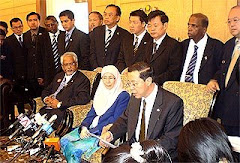
zambry perak state pc 130509 03Thus, His Royal Highness was right in making enquiries to satisfy himself as to whether Nizar had in fact ceased to command the confidence of the majority of the members of the Legislative Assembly, in considering Nizar' s request for the dissolution of the legislative assembly.
It took this judge 42 pages to reach this conclusion.
At the recent launch of my book, How to Judge the Judges, on 29 June 2009 Justice Gopal Sri Ram FCJ remarked, "But where a judgment is tainted with intellectual dishonesty there is nothing much you can do except to expose the fallacy of the grounds put forth to justify a conclusion already reached".
Now let us expose the fallacy of the finding of this judge.
The judge said that whether Nizar had ceased to command the majority in the Assembly could be established by other means. One may ask, what other means could there be? He could only give one example.
He said, "Thus, His Royal Highness was right in making enquiries to satisfy himself as to whether Nizar had in fact ceased to command the confidence of the majority of the members of the Legislative Assembly, in considering Nizar's request for the dissolution of the Legislative Assembly".
But, all of us know that the Sultan has no power to do anything except that which the law allows him. As professor Andrew Harding has correctly said in his essay 'Crisis of Confidence and Perak's Constitutional Impasse' dated June 8, 2009 which is featured on the web portals Malaysian Insider and loyarburok.com:
.... the issue seems to become, who was empowered to make the judgment as to whether the MB still had the confidence of a majority? The Judge gave a correct answer to this question by saying it is the legislature, not the head of state.
.....
But, as the Judge also said, it is in any event clear that the head of state is not given the power under Article 16(6), as he is under Article 16(2)(a), to make a judgment as to matters of confidence
The Judge in Professor Harding's essay is the much respected Mr. Justice Abdul Azis of the High Court.
Conclusion
I trust we have exposed the fallacy of the grounds put forth by the two judges of the Court of Appeal.
All of you, (the ordinary people) who have been informed of the relevant provisions of the Laws of the Constitution of Perak by reading this article, knew that there are only two clauses of Article 16 which apply to the points that really matter before the Court of Appeal.
In Clause (2)(a) the head of state is empowered to make a judgment as to matters of confidence. Whereas in Clause (6) he is not given the power to do so but the legislature is.
Justice Abdul Aziz in the High Court gave the correct answer by saying it is the legislature, not the head of state, who is empowered to make the judgment as to whether the MB still had the confidence of a majority.
And, I trust, all of you would agree with him.
Raus Sharif and Abmad Maarop JJCA are wrong. They are wrong because there is no empowering provision in Article 16(6). They did not apply the law as it stands.
Indeed they have blatantly refused to apply the Laws of the Constitution of Perak. They should be ashamed of themselves for not administering justice according to law. The common people of this country can now judge them for what they are.
The full text of the two judgments can be found on the Internet. If you, as a layman, find the judgments unintelligible then that is what the word gobbledygook means.
On the other hand, if you find the lengthy judgments merely repeating information which is unnecessary to the two points that matter in the appeal then that is precisely what regurgitation means.
So now you can appreciate the title of this essay.
NH CHAN is a former Court of Appeal judge famous for his 'All is not well in the House of Denmark' comment regarding judicial corruption. He was referring to the Kuala Lumpur High Court's commercial division located in Wisma Denmark. The quote is based on Shakespeare's 'Something is rotten in the state of Denmark'. He now lives in Ipoh.
Thursday, July 9, 2009

High Chaparral: State documents declassified - Star
Jul 9, 2009 By ANDREA FILMER
andrea@thestar.com.my
GEORGE TOWN: The state government has declassified confidential state executive council (exco) minutes of the previous Barisan Nasional administration pertaining to the alienation of Kampung Buah Pala land to a co-operative.
Chief Minister Lim Guan Eng said the state exco decided at its meeting Wednesday to declassify the documents after consulting and getting approval from the state legal adviser.
He said the records showed that the state government land was approved to Koperasi Pegawai Kerajaan Pulau Pinang twice on Aug 18, 2004 and June 8, 2005.
“The premium of RM6.42mil or RM20 per sq ft was subsequently reduced to RM3.21mil or RM10 per sq ft.
“So far, (former chief minister Tan Sri Dr Koh Tsu Koon) has not explained why he approved this project without consulting the villagers or why he sold it to the co-operative at such a low price,” he said in a statement here Thursday.
“If Barisan was in power now and not Pakatan Rakyat, the residents would have been evicted and the village would have been demolished since last year,” he claimed.
The impending demolition of Kampung Buah Pala, popularly known as Penang’s High Chaparral and regarded by some as a cultural icon, has become the biggest headache facing the Pakatan Rakyat administration.
andrea@thestar.com.my
GEORGE TOWN: The state government has declassified confidential state executive council (exco) minutes of the previous Barisan Nasional administration pertaining to the alienation of Kampung Buah Pala land to a co-operative.
Chief Minister Lim Guan Eng said the state exco decided at its meeting Wednesday to declassify the documents after consulting and getting approval from the state legal adviser.
He said the records showed that the state government land was approved to Koperasi Pegawai Kerajaan Pulau Pinang twice on Aug 18, 2004 and June 8, 2005.
“The premium of RM6.42mil or RM20 per sq ft was subsequently reduced to RM3.21mil or RM10 per sq ft.
“So far, (former chief minister Tan Sri Dr Koh Tsu Koon) has not explained why he approved this project without consulting the villagers or why he sold it to the co-operative at such a low price,” he said in a statement here Thursday.
“If Barisan was in power now and not Pakatan Rakyat, the residents would have been evicted and the village would have been demolished since last year,” he claimed.
The impending demolition of Kampung Buah Pala, popularly known as Penang’s High Chaparral and regarded by some as a cultural icon, has become the biggest headache facing the Pakatan Rakyat administration.
Thursday, July 2, 2009
Kedah DAP to quit Pakatan - Star
Jul 2, 2009
ALOR SETAR: The state DAP has decided to quit the Pakatan Rakyat citing “undelivered promises” by the Kedah government as one of the reasons.
The PAS-led state government was also accused of not giving equal treatment to all Kedahans.
State DAP chairman Thomas Su said the decision was made via a resolution yesterday, adding he would inform the DAP headquarters of it.
“This is our (Kedah DAP’s) decision. The final decision will be made by our national leaders,” he told reporters after witnessing the demolition of an illegal pig slaughterhouse by the Alor Setar City Council in Kampung Berjaya in Jalan Putra here yesterday.
The demolition of the slaughterhouse was another reason which had prompted the state DAP to quit the pact.
Su said the state DAP, which holds one seat in Kedah’s 36-seat legislature, was upset over the incident, accusing the state government of not handling the matter properly.
“Although the slaughterhouse was operating on land belonging to the Alor Setar City Council, the state government has the power to postpone the demolition. This will give more time for the Kedah Pig Traders and Slaughterer Association which operates the slaughterhouse to find a new site,” he said.
Mayor Datuk Khazali Din was quoted as saying recently that the abattoir had been erected illegally on the site for the past 30 years.
The council had ordered the association to vacate the place several times since 1995 with the latest in May this year.
At the Parliament lobby, Pakatan leader Datuk Seri Anwar Ibrahim said the pact’s leadership would discuss the matter today.
DAP Seputeh MP Teresa Kok said the Kedah DAP’s decision was “an act of frustration” as the state government had a number of unresolved issues in the past year.
“DAP has only one seat in Kedah. Many non-Malays come to them for help. Many of these issues are sensitive as well,” she said.
ALOR SETAR: The state DAP has decided to quit the Pakatan Rakyat citing “undelivered promises” by the Kedah government as one of the reasons.
The PAS-led state government was also accused of not giving equal treatment to all Kedahans.
State DAP chairman Thomas Su said the decision was made via a resolution yesterday, adding he would inform the DAP headquarters of it.
“This is our (Kedah DAP’s) decision. The final decision will be made by our national leaders,” he told reporters after witnessing the demolition of an illegal pig slaughterhouse by the Alor Setar City Council in Kampung Berjaya in Jalan Putra here yesterday.
The demolition of the slaughterhouse was another reason which had prompted the state DAP to quit the pact.
Su said the state DAP, which holds one seat in Kedah’s 36-seat legislature, was upset over the incident, accusing the state government of not handling the matter properly.
“Although the slaughterhouse was operating on land belonging to the Alor Setar City Council, the state government has the power to postpone the demolition. This will give more time for the Kedah Pig Traders and Slaughterer Association which operates the slaughterhouse to find a new site,” he said.
Mayor Datuk Khazali Din was quoted as saying recently that the abattoir had been erected illegally on the site for the past 30 years.
The council had ordered the association to vacate the place several times since 1995 with the latest in May this year.
At the Parliament lobby, Pakatan leader Datuk Seri Anwar Ibrahim said the pact’s leadership would discuss the matter today.
DAP Seputeh MP Teresa Kok said the Kedah DAP’s decision was “an act of frustration” as the state government had a number of unresolved issues in the past year.
“DAP has only one seat in Kedah. Many non-Malays come to them for help. Many of these issues are sensitive as well,” she said.
Wednesday, June 24, 2009
DNA bill passed, Anwar cries foul - Malaysiakini
S Pathmawathy and Tarani Palani | Jun 23, 09 7:43pm
 The Deoxyribonucleic Acid (DNA) Identification Bill was passed at the lower House and will be sent to senate for approval.
The controversial legislation was passed today after two days of intense debate, mostly by opposition parliamentarians who did their best to delay bill's passage as they claim it would be a disaster for legal and human rights.
The bill specifically gives the police and authorities the power to obtain DNA samples from any suspects who have direct links to a crime.
The committee level debate saw amendments being made to nine sections of the bill, which includes the appointment of the head of the DNA Databank, the deputy head and other officers.
Deputy Home Minister Abu Seman Yusop told the House that the post of the head of Databank will no longer be helmed by a police official but by a public officer, who is sufficiently qualified and has the requisite experience in DNA science.
Prior to the amendments, the home minister had to appoint a police officer not below the rank of a Deputy Commissioner to head the databank.
Before the amendments were made, a police officer was allowed to use all means necessary for the purpose of taking or assisting the taking of a non-intimate DNA samples from a person.
Now, the amendments give the person the prerogative to refuse giving a non-intimate sample to the magistrate.
In the committee stage of the rounding up speech, Abu Seman also proposed to remove two sections of the bill.
They are Section 14, which holds a person liable to a fine not exceeding RM10,000 or a prison term not exceeding one year or both and Section 24, which states any information from the DNA Databank would be construed as conclusive proof in any court proceedings.
Anwar: This is a malicious campaign
Although the bill passed does not affect obtaining intimate samples such as blood and semen, the Magistrate's Court can issues an order to obtain non-intimate samples like saliva.
The bill, which is divided into six parts and contains 27 Sections, was tabled in August last year for a second reading.
The objective of the legislation is to enable the establishment of a Malaysian Forensics DNA Data Bank which is expected to store and analyse samples.
Speaking to reporters at the Parliament lobby, Opposition Leader Anwar Ibrahim expressed disappointment with the passing of the bill.
"Pakatan Rakyat is convinced that the way they are rushing through and refusing to acknowledge some very (important) criticisms is clearly meant to be used during the my trial," said Anwar.
The Permatang Pauh MP suspects the bill is an attempt to trap him in his ongoing sodomy case which is set for trial in July.
"As far as I am concerned it is not an issue... we have to fight them with or without the bill. It is a malicious campaign, nothing more," he added.
Subang PKR MP R Sivarasa added that to be fair to the government, some proposals made by the opposition was taken into account.
Sivarasa also said that the bill will definitely have an impact on the Anwar sodomy trial as the prosecution would be able to use samples that have been collected way back, when Anwar was held under the Internal Security Act in 1998.
"They can use it to legitimise the illegitimate samples," said Sivarasa
 The Deoxyribonucleic Acid (DNA) Identification Bill was passed at the lower House and will be sent to senate for approval.
The controversial legislation was passed today after two days of intense debate, mostly by opposition parliamentarians who did their best to delay bill's passage as they claim it would be a disaster for legal and human rights.
The bill specifically gives the police and authorities the power to obtain DNA samples from any suspects who have direct links to a crime.
The committee level debate saw amendments being made to nine sections of the bill, which includes the appointment of the head of the DNA Databank, the deputy head and other officers.
Deputy Home Minister Abu Seman Yusop told the House that the post of the head of Databank will no longer be helmed by a police official but by a public officer, who is sufficiently qualified and has the requisite experience in DNA science.
Prior to the amendments, the home minister had to appoint a police officer not below the rank of a Deputy Commissioner to head the databank.
Before the amendments were made, a police officer was allowed to use all means necessary for the purpose of taking or assisting the taking of a non-intimate DNA samples from a person.
Now, the amendments give the person the prerogative to refuse giving a non-intimate sample to the magistrate.
In the committee stage of the rounding up speech, Abu Seman also proposed to remove two sections of the bill.
They are Section 14, which holds a person liable to a fine not exceeding RM10,000 or a prison term not exceeding one year or both and Section 24, which states any information from the DNA Databank would be construed as conclusive proof in any court proceedings.
Anwar: This is a malicious campaign
Although the bill passed does not affect obtaining intimate samples such as blood and semen, the Magistrate's Court can issues an order to obtain non-intimate samples like saliva.
The bill, which is divided into six parts and contains 27 Sections, was tabled in August last year for a second reading.
The objective of the legislation is to enable the establishment of a Malaysian Forensics DNA Data Bank which is expected to store and analyse samples.
Speaking to reporters at the Parliament lobby, Opposition Leader Anwar Ibrahim expressed disappointment with the passing of the bill.
"Pakatan Rakyat is convinced that the way they are rushing through and refusing to acknowledge some very (important) criticisms is clearly meant to be used during the my trial," said Anwar.
The Permatang Pauh MP suspects the bill is an attempt to trap him in his ongoing sodomy case which is set for trial in July.
"As far as I am concerned it is not an issue... we have to fight them with or without the bill. It is a malicious campaign, nothing more," he added.
Subang PKR MP R Sivarasa added that to be fair to the government, some proposals made by the opposition was taken into account.
Sivarasa also said that the bill will definitely have an impact on the Anwar sodomy trial as the prosecution would be able to use samples that have been collected way back, when Anwar was held under the Internal Security Act in 1998.
"They can use it to legitimise the illegitimate samples," said Sivarasa
Friday, June 19, 2009
Ong clarifies variation order - Star
June 19, 2009
PETALING JAYA: Transport Minister Datuk Seri Ong Tee Keat said that the RM1.2bil variation order for the Port Klang Free Zone project was approved by the Port Klang Authority board last year.
Ong said he received numerous queries on whether he had applied to the former prime minister to approve the variation order and that copies of official letters were also circulated on the Internet.
“The board had written to me, asking me to write to the then prime minister who was also the finance minister to apply for the additional funding,” he clarified in his blog posted yesterday.
“The authority was also at risk of defaulting payment as the deadline to meet its financial obligations was approaching,” Ong said, adding that he was merely relaying the decision of the board to the then PM.
He said he had just started his ministerial job less than two months ago at that time, and that the decision was made by the port authority before his tenure.
Ong also pointed out that PricewaterhouseCoopers had not even started its Position Review work.
“As the person who directed port authority to commission an independent report by a reputable international accounting firm, and asked for the findings to be made public, I have nothing to hide,” he said.
“If I did, I would not have commissioned the Position Review. From day one, I have requested nothing less than an impeccable level of transparency and accountability in tackling this issue and I mean what I say,” Ong stressed.
He said it was unfortunate that there were quarters who were uncomfortable with the matter and chose to spin “unfounded lies” about him.
“Many of them hide behind online anonymity to tarnish and discredit me, and even leak out official letters,” he said.
Ong added that it was deplorable that his representation in conveying the board’s decision could be spun by DAP adviser Lim Kit Siang as pressuring the Prime Minister.
PETALING JAYA: Transport Minister Datuk Seri Ong Tee Keat said that the RM1.2bil variation order for the Port Klang Free Zone project was approved by the Port Klang Authority board last year.
Ong said he received numerous queries on whether he had applied to the former prime minister to approve the variation order and that copies of official letters were also circulated on the Internet.
“The board had written to me, asking me to write to the then prime minister who was also the finance minister to apply for the additional funding,” he clarified in his blog posted yesterday.
“The authority was also at risk of defaulting payment as the deadline to meet its financial obligations was approaching,” Ong said, adding that he was merely relaying the decision of the board to the then PM.
He said he had just started his ministerial job less than two months ago at that time, and that the decision was made by the port authority before his tenure.
Ong also pointed out that PricewaterhouseCoopers had not even started its Position Review work.
“As the person who directed port authority to commission an independent report by a reputable international accounting firm, and asked for the findings to be made public, I have nothing to hide,” he said.
“If I did, I would not have commissioned the Position Review. From day one, I have requested nothing less than an impeccable level of transparency and accountability in tackling this issue and I mean what I say,” Ong stressed.
He said it was unfortunate that there were quarters who were uncomfortable with the matter and chose to spin “unfounded lies” about him.
“Many of them hide behind online anonymity to tarnish and discredit me, and even leak out official letters,” he said.
Ong added that it was deplorable that his representation in conveying the board’s decision could be spun by DAP adviser Lim Kit Siang as pressuring the Prime Minister.
From hare speed to tortoise pace. Why Not?
June 19, 2009 By WONG SAI WAN
Malaysia, once thought of as the forerunner in the multimedia sector, now lags behind on every front in what is supposedly our future.
A DOZEN years ago, the International Advisory Panel of the Multimedia Super Corridor (MSC) held its inaugural meeting at the Gates Building at Stanford University in Palo Alto, the heart of the US Silicon Valley which was, and still is, the heart of the cyberworld.
Then Prime Minister Datuk Seri (now Tun) Dr Mahathir Mohamad chaired the meeting and the members of the panel represented the who’s who of the electronic world then.
Sun Microsystems boss Scott McNeally was there. So was Acer founder Stan Shih and Sony’s Nobuyuki Idei. Also present were venture capitalist James Barksdale and then Compaq CEO Eckhard Pfeifer and then Cisco Systems CEO (now chairman) John Chambers.
The only one missing was Microsoft head honcho Bill Gates. But Dr Mahathir had met him a year earlier and was to meet him again the day following the meeting.
Everyone was abuzz with Malaysia’s idea of a dedicated area just for the development of the cyberworld – which was then just known as multimedia. All of them wanted a piece of the MSC then.
It was a proud moment to be a Malaysian that week and I was fortunate to be there to witness the whole thing. Dr Mahathir was leading a huge business delegation to the United States to promote the MSC, then thought of by the world as a groundbreaking idea.
The concept of a triumvirate – the people, business and the Government – working in concert to make the MSC a reality sounded so attractive.
The Government also drafted laws to protect the MSC so that it would be a truly free environment that would allow ideas to bloom.
That was then. Along came the Asian financial crisis and the sacking of Datuk Seri Anwar Ibrahim (his black eye and the sordid trial put paid to the pride that was felt all those years ago). We had since been recovering slowly.
Then came last week. I met two Europeans at a golf game – one a Swiss whom I shall call Johann, and the other a French whom I will refer to as Pierre.
The two men are chief executives of multi-national companies with manufacturing plants in Malaysia and the region.
While Johann had arrived in the country less than a month ago, Pierre is a 10-year veteran who has seen Malaysia at its best and worst.
The two noticed me typing away on my Blackberry phone and inquired if I found the device useful. Their question set me off on how my life has changed with the BB (Blackberry for the uninitiated).
From there, our conversation turned to the Internet or more accurately, the lack of it.
The two men spent about 30 minutes bemoaning the lack of speed, and how their lives had been badly affected by the slow speed of Internet services in Malaysia.
“My kids made a video to wish their grandfather happy birthday. It was not a very big file – less than 120 megabytes,” said Pierre.
“It took me more than two hours to upload the file and send it to my brother in France so he can show our father.
“In France, my brother took just 10 minutes to download the same file.”
Johann’s crestfallen face spoke volumes when it came to his turn to tell his sad tale of Malaysia’s Internet services.
“I am so used to our Swiss speed. I only get 30 megabits per second when downloading. Malaysia’s Internet connection is just too slow,” he said.
At this juncture, my patriotism kicked in and I tried to justify the situation to these two Europeans, but after a while I found myself agreeing with everything they said.
There was nothing good I could say about Malaysian cyber connections.
The best I could come out with was to ask them to be patient as the Government had initiated the National Broadband Project and that in a few years the whole of the Klang Valley would be wired up.
Pierre and Johann both gave me that “you got to be kidding” look. The Swiss pointed out that all towns in his home country had put in fibre optics years ago.
“They just dug and dug and wired everyone up. What are you all waiting for?” he asked.
He was “very impressed” when he first came to Malaysia 10 years ago.
“You all then had ADSL lines when we in France were still using dial-ups,” he recalled.
“But what happened? We are now surfing at real broadband speed and not the ‘best service possible’ practice as you have here in Malaysia.
“Johann, if you get 50% of the promised speed in Malaysia, consider yourself lucky.”
The conversation went downhill from there on and all three of us took swipes at the various Internet service providers in Malaysia.
Whatever national pride I had for our cyber venture was shattered in my conversation with Johann and Pierre.
When I got home, I tested my 1-megabit-per-second broadband speed. The result was depressing – the download speed was 406 kilobits per second and upload was 307 kilobits per second. Pierre was right – I could not even get 50% of the speed promised.
On Tuesday, Science, Technology and Innovation Minister Datuk Dr Maximus Ongkili will be a guest on The Star Online Live Chat programme.
He can be sure that although I will be away in Sweden attending a global conference by Ericsson on the future of the communication world, I will be e-mailing him some questions and giving him my opinion of our tortoise-speed Internet connections.
Deputy Executive Editor Wong Sai Wan spends every free time Twitting, and is now totally dependent on his Blackberry to update his Facebook
Malaysia, once thought of as the forerunner in the multimedia sector, now lags behind on every front in what is supposedly our future.
A DOZEN years ago, the International Advisory Panel of the Multimedia Super Corridor (MSC) held its inaugural meeting at the Gates Building at Stanford University in Palo Alto, the heart of the US Silicon Valley which was, and still is, the heart of the cyberworld.
Then Prime Minister Datuk Seri (now Tun) Dr Mahathir Mohamad chaired the meeting and the members of the panel represented the who’s who of the electronic world then.
Sun Microsystems boss Scott McNeally was there. So was Acer founder Stan Shih and Sony’s Nobuyuki Idei. Also present were venture capitalist James Barksdale and then Compaq CEO Eckhard Pfeifer and then Cisco Systems CEO (now chairman) John Chambers.
The only one missing was Microsoft head honcho Bill Gates. But Dr Mahathir had met him a year earlier and was to meet him again the day following the meeting.
Everyone was abuzz with Malaysia’s idea of a dedicated area just for the development of the cyberworld – which was then just known as multimedia. All of them wanted a piece of the MSC then.
It was a proud moment to be a Malaysian that week and I was fortunate to be there to witness the whole thing. Dr Mahathir was leading a huge business delegation to the United States to promote the MSC, then thought of by the world as a groundbreaking idea.
The concept of a triumvirate – the people, business and the Government – working in concert to make the MSC a reality sounded so attractive.
The Government also drafted laws to protect the MSC so that it would be a truly free environment that would allow ideas to bloom.
That was then. Along came the Asian financial crisis and the sacking of Datuk Seri Anwar Ibrahim (his black eye and the sordid trial put paid to the pride that was felt all those years ago). We had since been recovering slowly.
Then came last week. I met two Europeans at a golf game – one a Swiss whom I shall call Johann, and the other a French whom I will refer to as Pierre.
The two men are chief executives of multi-national companies with manufacturing plants in Malaysia and the region.
While Johann had arrived in the country less than a month ago, Pierre is a 10-year veteran who has seen Malaysia at its best and worst.
The two noticed me typing away on my Blackberry phone and inquired if I found the device useful. Their question set me off on how my life has changed with the BB (Blackberry for the uninitiated).
From there, our conversation turned to the Internet or more accurately, the lack of it.
The two men spent about 30 minutes bemoaning the lack of speed, and how their lives had been badly affected by the slow speed of Internet services in Malaysia.
“My kids made a video to wish their grandfather happy birthday. It was not a very big file – less than 120 megabytes,” said Pierre.
“It took me more than two hours to upload the file and send it to my brother in France so he can show our father.
“In France, my brother took just 10 minutes to download the same file.”
Johann’s crestfallen face spoke volumes when it came to his turn to tell his sad tale of Malaysia’s Internet services.
“I am so used to our Swiss speed. I only get 30 megabits per second when downloading. Malaysia’s Internet connection is just too slow,” he said.
At this juncture, my patriotism kicked in and I tried to justify the situation to these two Europeans, but after a while I found myself agreeing with everything they said.
There was nothing good I could say about Malaysian cyber connections.
The best I could come out with was to ask them to be patient as the Government had initiated the National Broadband Project and that in a few years the whole of the Klang Valley would be wired up.
Pierre and Johann both gave me that “you got to be kidding” look. The Swiss pointed out that all towns in his home country had put in fibre optics years ago.
“They just dug and dug and wired everyone up. What are you all waiting for?” he asked.
He was “very impressed” when he first came to Malaysia 10 years ago.
“You all then had ADSL lines when we in France were still using dial-ups,” he recalled.
“But what happened? We are now surfing at real broadband speed and not the ‘best service possible’ practice as you have here in Malaysia.
“Johann, if you get 50% of the promised speed in Malaysia, consider yourself lucky.”
The conversation went downhill from there on and all three of us took swipes at the various Internet service providers in Malaysia.
Whatever national pride I had for our cyber venture was shattered in my conversation with Johann and Pierre.
When I got home, I tested my 1-megabit-per-second broadband speed. The result was depressing – the download speed was 406 kilobits per second and upload was 307 kilobits per second. Pierre was right – I could not even get 50% of the speed promised.
On Tuesday, Science, Technology and Innovation Minister Datuk Dr Maximus Ongkili will be a guest on The Star Online Live Chat programme.
He can be sure that although I will be away in Sweden attending a global conference by Ericsson on the future of the communication world, I will be e-mailing him some questions and giving him my opinion of our tortoise-speed Internet connections.
Deputy Executive Editor Wong Sai Wan spends every free time Twitting, and is now totally dependent on his Blackberry to update his Facebook
Subscribe to:
Posts (Atom)